With AI fever still burning hot across industries, you have to wonder: how will it be solidified in the day-to-day? Sure, we’re all dabbling in asking our favourite chatbot veterinary questions or generating emails to our boss, but in vet tech, AI becomes a superpower if harnessed correctly.
In 2025, we published an in-depth article on AI in veterinary technology, considering the many applications, from transcribing SOAP notes to diagnosis support.
Today’s story centres on a pet startup that is ahead of the curve when it comes to AI innovation in vet tech. AI FOR PET is the story of one pet lover’s expertise in AI, her mission to bridge the gap between technology and vet care and the passionate team of innovators she recruited to build the tool of the future.
We spoke to Ronnie Hyun, Vice President and CSO, and Dr Hyun-Jung Kim, Chief Veterinary Officer and R&D Lead, to learn more about their story.
A 2020 launch
As with many founding stories we’ve shared on the Unleashed by Purina platform, AI FOR PET began with an ailing pet. Specifically, Founder and CEO Euna Huh’s dog was having an issue with his eye. Googling could only get her so far in her research, and this was in 2020, when the height of the pandemic limited access to veterinary care.
With 25 years of experience within the Big Data and AI spaces, Euna Huh began to wonder: could AI be better utilised to improve pet healthcare?
Huh considered multiple angles for developing the technology.
Hyun said, “[Our founder] worked with colleagues to create an algorithm that helps veterinarians. The goal was to integrate logic from Big Data and collect data from clinics, so they could create a clinical-grade AI”.
So what did Euna Huh and the AI FOR PET team create? Their proprietary software, TTCare, analyses and structures multimodal data (image and video) as well as clinical data to support veterinary processes.
Hyun said, “We can analyse teeth, eyes, skin and gait. Based on this, with our clinical-grade data standard, we provide veterinarians with real-time decision-making support. This is our core technology and solution for vet clinics”.
Dr Kim echoed those statements with her personal clinical experience. She said, “We find that the outer surface of animals can mirror the inner surface. So our technology looks at the outer surface in detail. It’s a way to speed up the communication between pet owners and veterinarians. We also focus on areas that many veterinarians find difficult to analyse. For example, gait analysis is one of the most difficult areas”.
Within a year, TTCare was approved as Korea’s first AI-based veterinary software by the Korean government and secured its first rounds of seed funding.
With a great product in hand, it was time to grow the team and stretch the bounds of what this technology could do.
Rapid innovation, backed by data
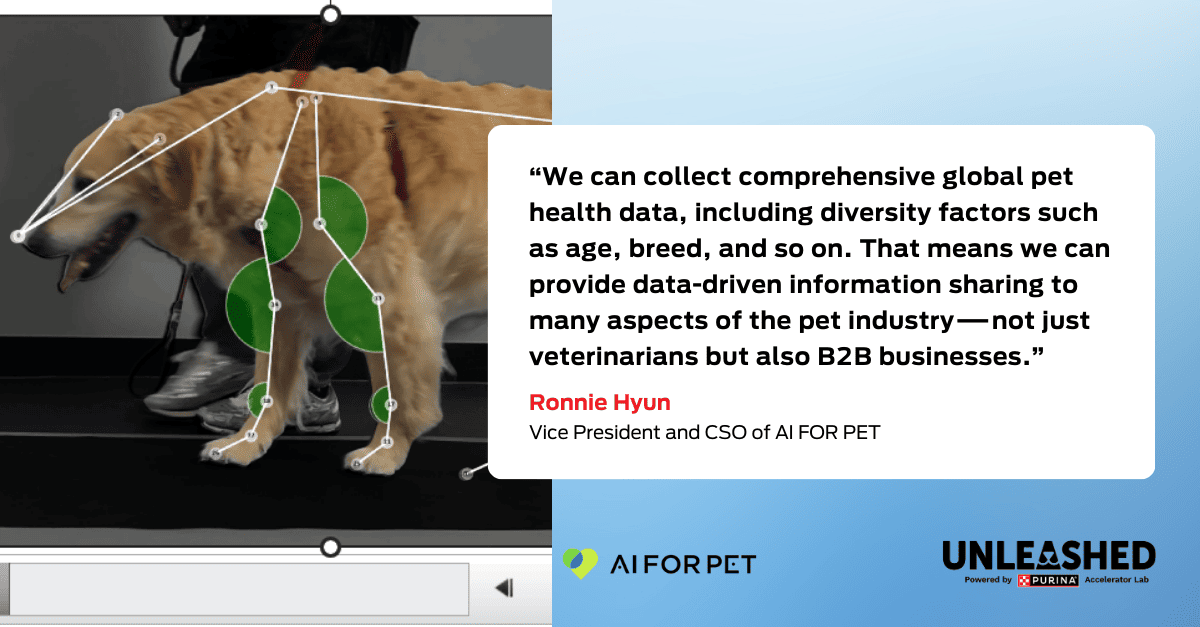
In the previous section, there may have been one term that caught your attention. It certainly caught mine. Gait analysis. You may have heard of skin analysis, eye analysis or even pain indicators, but gait analysis stood out as something new, complex and infinitely impressive.
Dr Kim explained that the primary goal for this feature isn’t initial diagnosis, but rather rehabilitation monitoring.
She said, “Making a diagnosis is sometimes easier if the dog's showing a very significant lameness. You don't need that kind of tool. But it’s much more difficult to figure out whether the dog is getting better day by day or weekly. So our goal is to be a powerful tool for monitoring progress and communicating the results with pet owners”.
And their work in developing this feature has paid off. In January 2026, a paper written and researched by the AI FOR PET team was published in the American Journal of Veterinary Research, supporting its potential clinical utility.
But this is just one milestone the company has achieved.
From winning a Pet Innovation Award in 2023 to Silicon Valley’s Unicorn Pitch in 2024, the company went from strength to strength in terms of widespread excitement around the technology and endorsement from the pet world on its true potential.
Naturally, once the technology was validated and recognised, it was time to take it to market.
10% market share in 10 months
South Korea is one of the most exciting territories for pet tech innovation. The overall pet care market value exceeded approximately USD 1.4 billion in 2024, driven mainly by pet food. Pet ownership has been steadily increasing too, hitting 15 million people in 2025—that’s around a third of the population.
In 2025, TTCare was integrated with the top PIMS software company in Korea and began its journey in real-life vet clinics. They now operate in 300 vet clinics, which represents around a 10% market share within Korea’s small animal vet clinics.
Hyun said, “We went to market in Q3 2025 and are already at 10% market share. So our retention is over 90%. We’re already locked in Korea, so we want to expand”.
But this fast growth was not without its challenges. A key part of commercialising within the veterinary space is having validated data sets and backed research to train the AI, which was a huge focus for the AI FOR PET team.
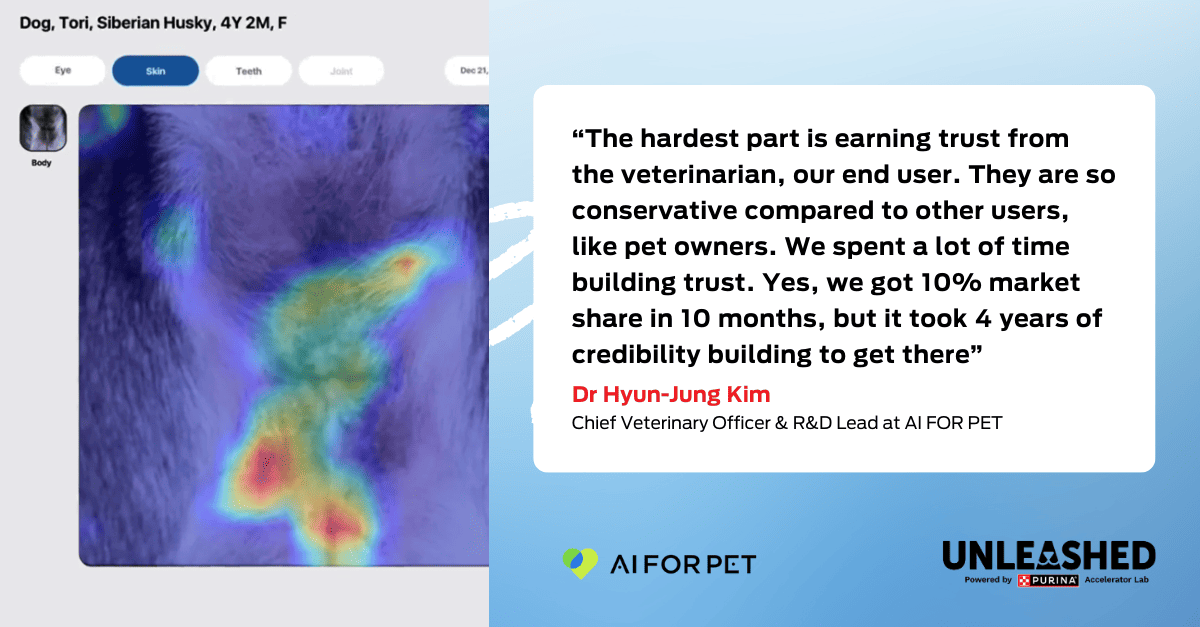
Dr Kim told me, “The hardest part is earning trust from the veterinarian, our end user. They are so conservative compared to other users, like pet owners. We spent a lot of time building trust. Yes, we got 10% market share in 6 months, but it took 4 years of credibility building to get there”.
As a home territory, Korea is great for startups because the local population is known to be quite tech-forward. However, there are limits to your growth here.
Hyun said, “Korea is not a big country. Although we have a big range in terms of purchasing capability, the market share for local brands is still small. That's why we want to go beyond Korea.”
Beyond just establishing a Silicon Valley office, the AI FOR PET team are taking innovative paths to further their reach. Dr Kim has been collaborating with U.S. universities, such as Ohio University, to further validate and stretch the bounds of the technology. Widening reach was also one of the reasons why AI FOR PET decided to apply to the Unleashed by Purina programme in 2026.
Joining the Class of 2026
The Unleashed by Purina team hosted AI FOR PET at our startup village during the 2025 London Vet Show. There, the team won the pitch competition due to an impressive presentation on how their product solves a real-life challenge within the veterinary industry and uses novel AI algorithms trained on real, validated clinical data.
When I asked Ronnie Hyun why the team decided to apply to the Unleashed by Purina accelerator programme of 2026, he told me about the vision they have for the next evolution of the technology.
“We want to create a personalised [pet food] nutrition recommendation programme by mapping together real-time clinical data from vet clinics”, Hyun said.
By recommending pet food products at the point of information, the TTCare system could be quite groundbreaking in bridging the gap between typical veterinary knowledge and up-to-date nutrition information.
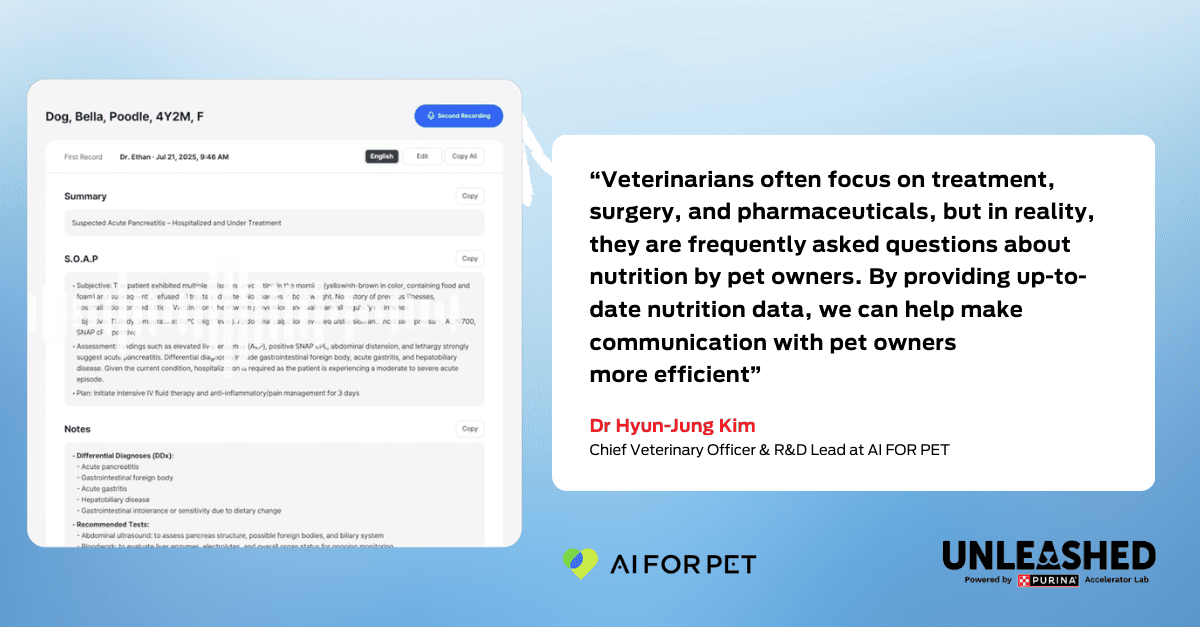
Dr Kim said, “Veterinarians often focus on treatment, surgery, and pharmaceuticals, but in reality, they are frequently asked questions about nutrition by pet owners. By providing up-to-date nutrition data, we can help make communication with pet owners more efficient.”
(If you want to be part of the next Unleashed by Purina accelerator programme, join our newsletter for the latest updates!)
What’s next for AI FOR PET?
It’s always exciting to see such a young company's breakthrough in the industry and pioneer new avenues for AI in vet care. With such rapid advancement underway, I asked, “what’s next?”
The answer? To widen the scope of TTCare’s technological capabilities in almost every way.
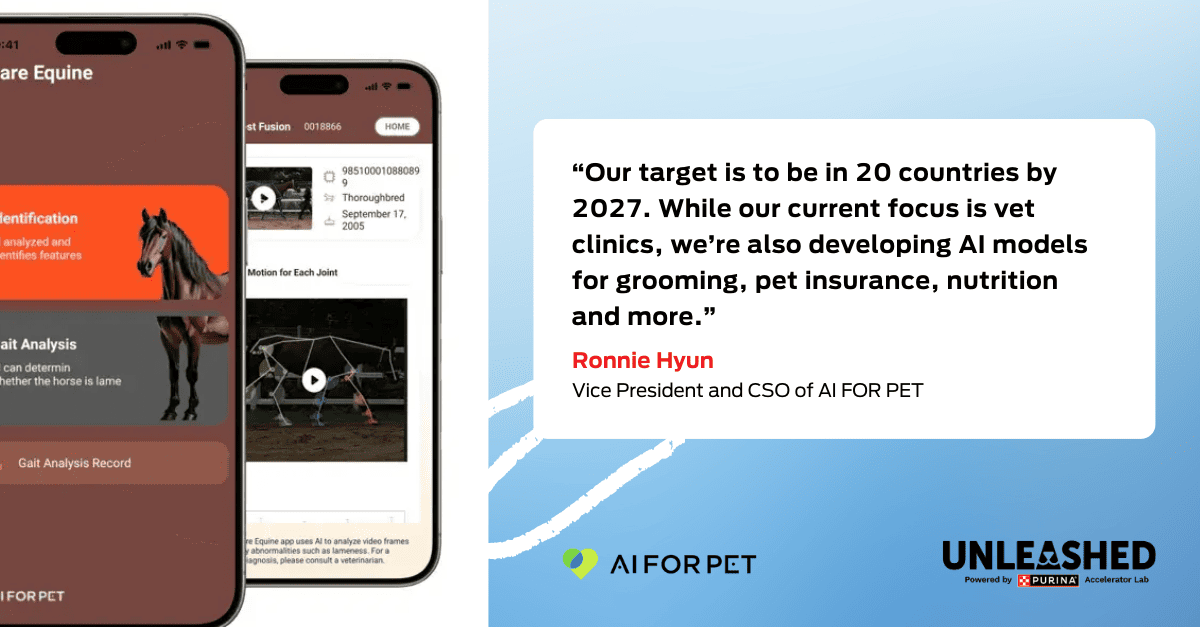
Hyun said, “Our target is to be in 20 countries by 2027. While our current focus is vet clinics, we’re also developing AI models for grooming, pet insurance, nutrition and more”.
With such a far reach into multiple aspects of the pet industry, it’s entirely possible for AI FOR PET to become a valuable data hub for pet health data across continents.
“We can collect comprehensive global pet health data, including diversity factors such as age, breed and so on. That means we can provide data-driven information sharing to many aspects of the pet industry—not just veterinarians but also B2B businesses”, Hyun continued.
Another factor is, of course, the customer requests flooding in.
Dr Kim told me, “We have got a lot of requests from veterinary professionals, not only from the eye, skin, dental and gait, but also from other parts. It could be something like behaviour, urgent care or even outside of small animal pets like zoo animals or livestock”.
It seems like AI FOR PET’s future goes far beyond the bounds we normally see with pet startups, both geographically and zoologically. We’re thrilled to be part of their journey and await to see the next phase of their ambitious evolution.
Written by Olivia De Santos, Pet Tech Writer @ Unleashed by Purina.