The anxiety, excitement and curiosity around AI are stronger than ever before. No industry is immune. And yet, we all know that some sectors of the pet industry are more tech-happy than others.
Given the veterinary industry’s reputation as relatively traditional and cautious, one could assume that vets are more resistant to the AI revolution than, say, the e-commerce or pet food supply chain sectors.
But is that really true?
In today’s article, we speak to clinicians, veterinary educators and vet tech startups on the opportunities and challenges of AI in vet tech. We’ll discuss how AI is being used today, the reception of AI tech within the vet community and the untapped opportunities real vets are asking for.
The state of veterinary medicine today
Veterinary medicine is under immense pressure.
In fact, veterinary professionals show some of the highest psychological distress rates in healthcare, with an estimated 30-40% of American veterinarians experiencing burnout, and 1 in 3 considering leaving the field altogether because of it.
But this is not just a US phenomenon. According to VetSurvey, 90% of veterinarians in Europe report high stress levels, and 2 in 3 report regularly working out of hours.
Many attribute this high stress in veterinary medicine to staff shortages and rising caseloads due to the increase in pet ownership, leaving vets stretched thin.
At the same time, pet parents are arriving more informed—albeit occasionally overwhelmed—by online and AI-generated advice, raising expectations for faster answers and clearer communication.
Against this backdrop, many clinicians are cautiously optimistic about AI: not as a replacement for clinical judgement, but as a potential ally that could ease workload, streamline documentation and support better decision-making when validated properly. So it’s no surprise that, according to a survey by GlobalPets, around 40% of vets are using AI regularly.
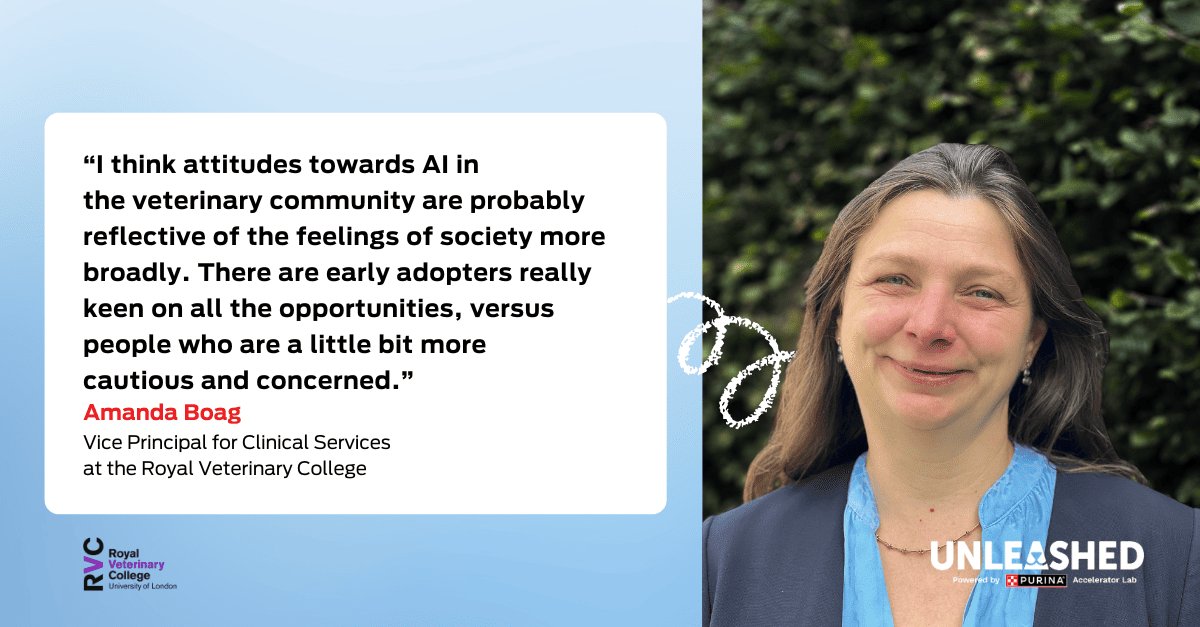
Amanda Boag, Vice Principal of Clinical Services at the Royal Veterinary College, told us, “I think attitudes towards AI in the veterinary community is probably reflective of the feelings of society more broadly. There are early adopters really keen on all the opportunities versus people who are a little bit more cautious and concerned”.
For those willing to adopt AI early, how can it realistically help vets alleviate some of the strain that they so often experience day-to-day? Let’s find out.
How AI can help vets
AI can be used in an infinite number of ways to help ease some of the challenges vets face whilst practising veterinary medicine today. Amanda Boag suggests there are two main camps where AI could be the most useful: operational support and clinical support.
AI in operational support
From practice management to SOAP summaries, documentation organisation to consultation scribing, AI has the impeccable ability to save already stretched veterinary surgeons and vet technicians both time and energy.
A 2025 survey, by the Federation of Veterinarians in Europe, reported that 65% of vets have seen their administrative tasks double in recent years. This is where AI comes into its own; the veterinary community celebrates and greatly benefits from the efficiency of AI operational support.
Amanda Boag said, “AI clinic efficiency tools, I think, are being very, very much welcomed”.
However, given that burnout among veterinarians is so widespread, I wondered whether using a new operational tool could create more of a strain and less relief. Amanda’s view is one of optimism.
“I think the benefits from the improvements in efficiency, and supporting clinicians and clinical teams to manage their time outweigh that”.
AI in clinical support
Using AI in clinical applications—for example, AI-optimised imaging tools or diagnosis chatbots—understandably adds a little more cautiousness within the vet community than operational tools do. After all, the lives of animals are in their hands, and a hallucination by an AI could have fatal consequences.
But Amanda doesn’t see this as a hindrance. Instead, she underlines the importance of clinical validation. “"I think there's a lot of potential for AI tools to support, not replace, the veterinary surgeon, but support the diagnostics, whether that is support with reading X-rays or cytology support. However, it's so important that we have validation and that the data sets that are used to train the models are really clear and transparent”.
That said, AI is unique within the field of medicine in that it starts imperfect.
So, to some degree, it takes a leap of faith to incorporate AI tools in a clinical setting. Fortunately, studies on the accuracy of clinical AI tools have been extremely successful so far. A 2025 study showed that commercial AI software matched the best veterinary radiologist’s interpretations in terms of accuracy and specificity when reviewing canine and feline radiographs. Results like these are only set to improve as AI technology advances.

The innovators changing the game
A report by Full Slice named 30+ vet tech AI tools, with the majority launching between 2018 and 2024. Of course, this just scrapes the surface and doesn’t account for the innovations beyond the United States, but it goes to show that the sector is growing rapidly. We can break up the current array of AI tools on the market into three categories.
Scribes and admin assistants
These are the operational tools, tackling everything from consultation scribing to PIMS integration. One such tool is the Veterinarian Exam Assistant, founded by accomplished AI and healthcare chatbot expert, Patricia Porter.
She said, “"The way VEA works is it listens to what the veterinarian is saying, then it will synthesize that information, look at past medical history, evaluate lab results and come up with suggestions that the veterinarian can include in the treatment plan, SOAP notes and take-home instructions”.
Similarly, Unleashed by Purina alum, knok, is developing an integrated AI tool.
Gil Figueira, Pet Division Manager at knok, said, “"Our AI co-pilot is based on an LLM, so it can process natural language. As a vet is doing their consultation in the background, the AI is understanding and interpreting everything that is going on. With a few clicks, the person will have a more oriented journey for the disease of their pet and can provide better care in a natural and effortless way”.
Both companies mentioned adoption as one of the key challenges in developing an AI tool for vets. However, the future looks bright for them. A study by Digitail showed that only 15% of American vets surveyed expressed a clear opposition to AI and 39.2% use AI regularly. And those who use it, love it! The same study mentions that 70% of participants, who reported using AI, use it daily with record-keeping/admin among the top three use cases.
Diagnosis and decision support
One could argue that the administrative assistants, like VEA and knok’s soon-to-be-launched tool, are also instrumental to diagnosis support. knok’s tool will have treatment recommendations, while VEA has developed a point-of-care education layer that gives vets medical and nutritional advice tailored to the pet’s condition.
AITEM, another Unleashed by Purina alum, have developed an LLM-based chatbot for vets called LAIKA to assist with clinical-decision making.
That said, there is also a great opportunity for clinical tools themselves to be AI-optimised.
Amanda Boag from the Royal Veterinary College mentioned their collaboration with the University of Cambridge to test the effectiveness of machine-learning algorithms to automatically detect and grade heart murmurs with adapted electronic stethoscopes. And it was highly successful! The algorithm detected murmurs of any grade with a sensitivity of 87.9%.
Radiology has had quite a few helpful additions too, such as tools that create AI-radiology supports using the data from the in-practice equipment. A recent study testing the effectiveness of AI in detecting common technical errors in canine thoracic radiography showed an overall accuracy of 81%.
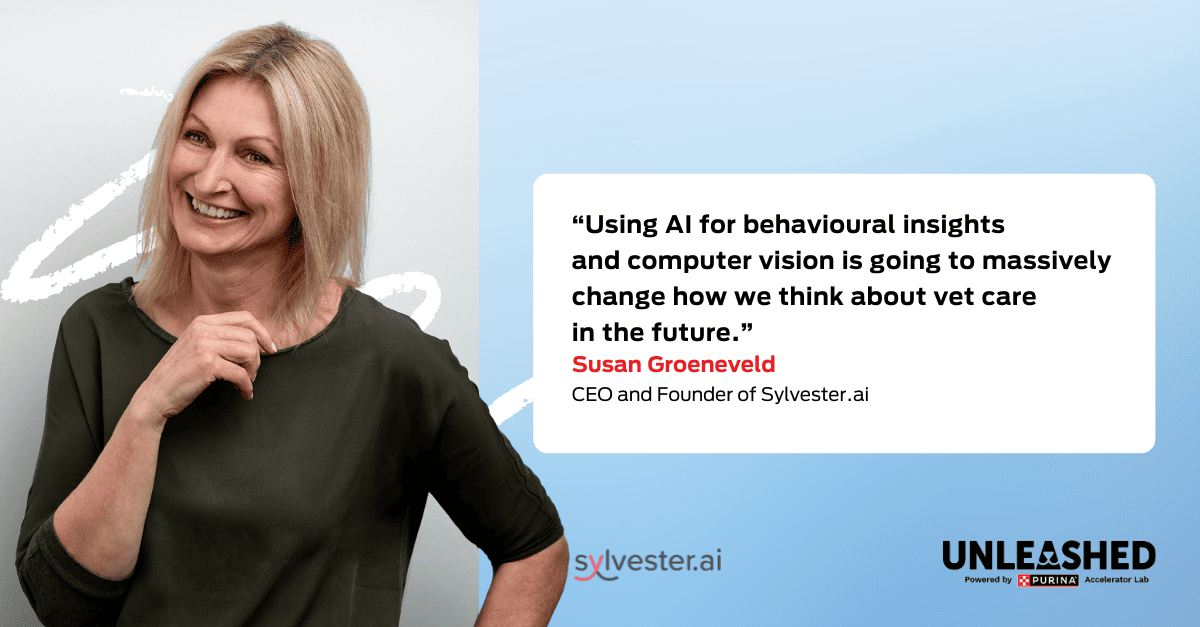
Then there are specialised species-specific tools like Sylvester.ai, which also happens to be an Unleashed by Purina alum. Sylvester.ai is an API-based tool that can detect pain signals on the faces of cats, who are famous for hiding their pain.
When asked about how vets have been adopting the tool, Susan Groeneveld, CEO and Founder of Sylvester.ai, said, “There are two camps of veterinarians that we've talked with. There is a group that wants every tool in their clinic, whether it's a pharma product, or a diagnostic, to be absolutely precise, and frankly it should be. And some of these folks have a ‘build it and they will come mentality’, which has worked very well in the past. Then there's another group rapidly emerging that can see the consumer changing and meeting the consumer where the consumer wants to be met. That second group isn't worried about Dr. Chat GPT as much. They're actually trying to build that rapport and build that relationship with the pet owner, leaning into tools that build trust together”.
The growing confidence around Sylvester.ai as an in-clinic tool led to them partnering with AI-scribe, CoVet, in 2025.
Telehealth and at-home tools
When we think about vet tech, we often focus on in-clinic tools. But at-home vet care can be just as, if not more, transformational to overall pet health and wellbeing.
Kristin Wuhrman, Founder and CXO at CatsOnly Veterinary Services, said, “The home part is really the high value here, because that's where we get the most accurate behaviour picture, what we don't see in the exam room. So, what can we gather from the caregiver and the patient in all the time between visits?”.
And many companies have approached the “out of clinic” question in different ways.
For instance, Unleashed by Purina alum, Zumvet created an AI tool that enables digital triaging and telemedicine consultations.
Though, admittedly, the adoption of telehealth tools among pet parents is currently quite low. A recent Gallup study suggests that 37% of US pet parents would be interested in using a telehealth service for their pet, but only 9% of respondents have.
We could also consider at-home diagnostics as a key innovation in this sector too. Unleashed by Purina alum, Pezz Life, is a good example of a preventative care startup bringing veterinary care to the home. The global pet at-home diagnostic tests market size was estimated at USD 80.14 million in 2024 and is projected to reach USD 110.97 million by 2030.
Though of course, there are other methods. Wuhrman and her team, who are building a network of cat-only vet clinics and hospitals, are approaching the question of at-home signals differently. She said, “We’re designing our platform so the right tools, including AI, work together seamlessly. Our goal is one connected experience from our systems in the clinic to what happens at home, for the team and for the family”.
What vets want
Though there are new AI-led vet tech tools popping up every day, here are the requests real vets have for pet tech innovators:
Smoother integration
The topic of integration and cohesive ecosystems came up repeatedly during my interviews with both founders and clinicians.
Susan Groeneveld, CEO and Founder of Sylvester.ai, said, “The future is full of integrations; it may be that one digital platform manages a whole species-centric approach with the pet owner and the clinic and also the time in between vet visits”.
But this is just one aspect of integration. The flip side is having tools that seamlessly integrate with a veterinarian's current workflow. But, if an AI tool adds too many extra steps to a clinician’s day, it’s unlikely to reach wide appeal. After all, we wouldn’t want to add to the several hours of often unpaid admin that vets do every week simply to learn how to use an AI tool. As ever, frictionless solutions champion over steep learning curves.
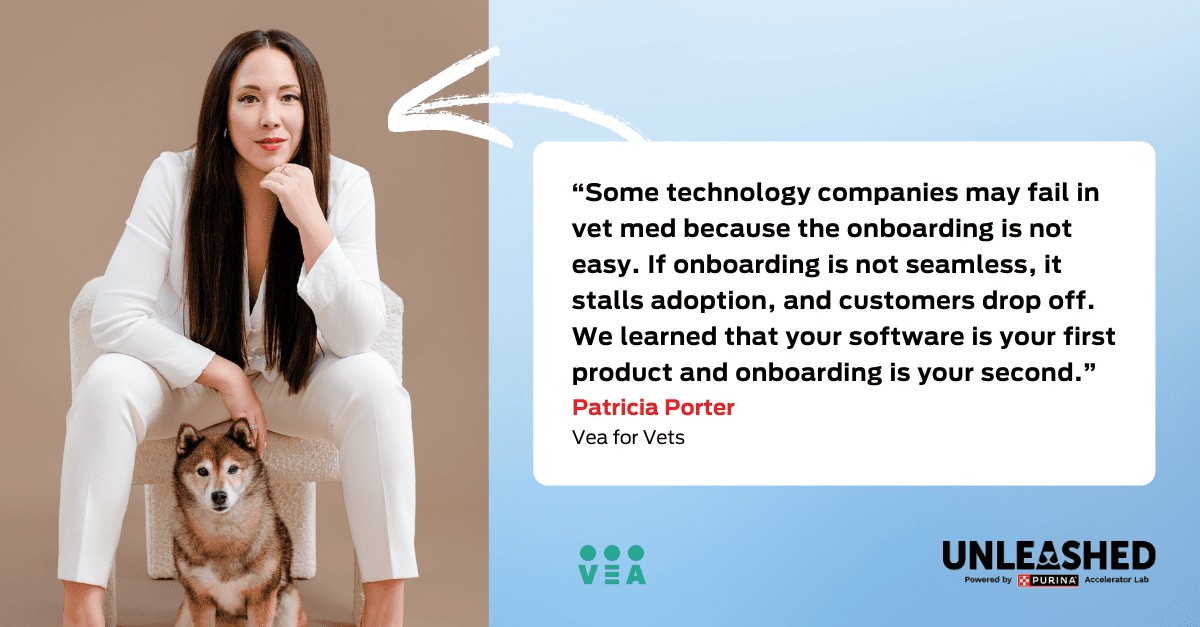
Founder and CEO of Veterinarian Exam Assistant, Patricia Porter, mentioned how AI vet-tech companies can make onboarding more seamless. She said, “Some technology companies may fail in vet med because the onboarding is not easy. If onboarding is not seamless, it stalls adoption, and customers drop off. We learned that your software is your first product, and onboarding is your second”.
Data management
According to a survey of over 3,000 American Animal Hospital Association members, one of the most useful applications of AI is the streamlining of admin, including the storage, organisation and summary of patient records, results and SOAP notes.
As a small animal vet, Gil Figueira from knok mentioned that he uses an AI tool to upload veterinary books to pull information more readily when needed. When speaking about the AI tool that knok is developing, he said, “We're already using AI to create clinical records, and so far, the reception has been very good as it saves a lot of time”.
Of course, innovators must also be mindful of privacy concerns, which is an ongoing debate around AI tools in general. The 2025 Digitail study showed that a vets second most prevalent concern when using AI is data privacy.
Collaborative care
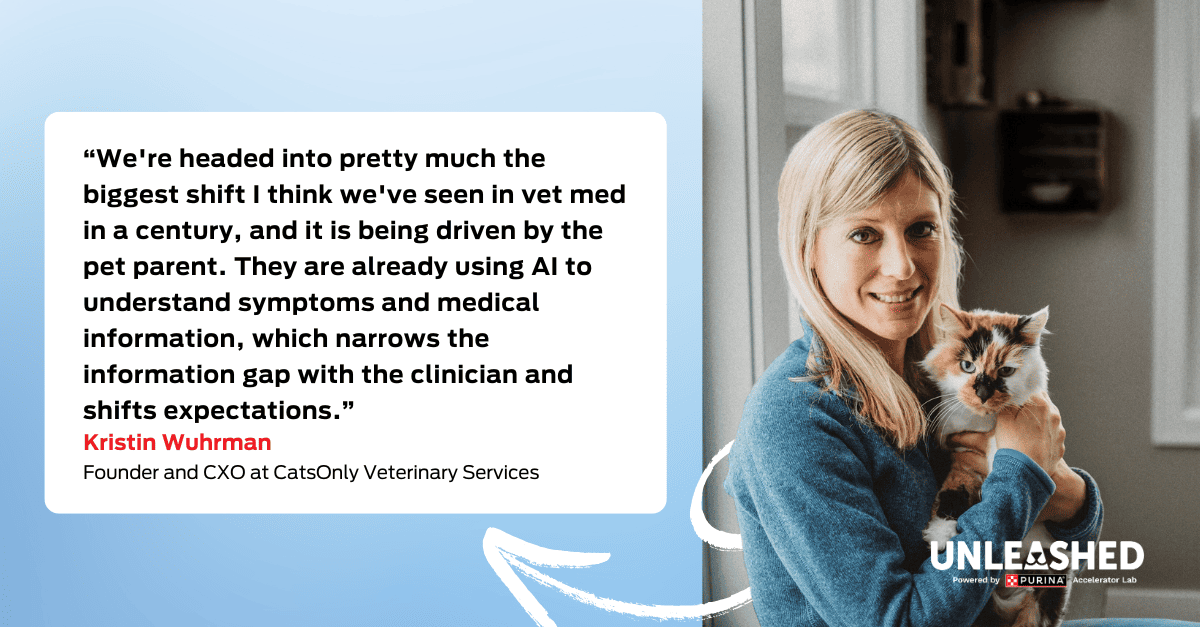
I first heard the term “collaborative care” from Kristin Wuhrman when discussing the increased concern of pet parents today. She said, “We're headed into pretty much the biggest shift I think we've seen in vet med in a century, and it is being driven by the pet parent. They are already using AI to understand symptoms and medical information, which narrows the information gap with the clinician and shifts expectations, so the profession will naturally evolve along with them”.
And it’s true. More people are using AI to ask questions about their own health and that of their pets. They’re also tracking their pet’s health in new ways. By plugging the gap between at-home signals and in-clinic analysis, a vet can have a more comprehensive picture of the pet’s behaviour and general health patterns over time.
While apps like Slyvester.ai empower cat parents to keep a closer eye on their cat’s pain signals, there is plenty of opportunity here to build comprehensive tools that monitor a pet’s health at home over time and perhaps even directly feed that information back to the vet when prompted.
AI-optimised clinical tools
In the diagnosis and decision support section, we discuss various ai-optimised tools like the AI stethoscope.
Amanda Boag said “On the clinical support side, a tool that can be used in practice with in-house tools that integrate an individual patient's past historical information, along with a range of different other clinical inputs, would be incredibly useful”.
Optimised tools should never replace the vet’s expertise, but instead provide further insight to support the vet in their analysis and eventual diagnosis. Integration comes in here too, as a tool that could pull from an ailing pet’s other test results and health history would further assist a more comprehensive diagnosis.
Return on investment
This is a sensitive one but it must be said! One of a veterinary practice’s primary concerns when bringing on new tools is the cost. Especially when you consider that, given the absence of integrations and established ecosystems, a vet practice may need an entire suite of tools that stack up in cost.
Veterinary clinics often run on thin margins, with the British Veterinary Association recently reporting that half of vet practices surveyed had profit margins lower than 15%. Benchmarks in the US are at a similar range of 10-15%.
Return on investment can be measured in multiple ways. For example, a PIMS integrated tool may save time and administrative strain, while an at-home or telehealth tool could drive more vet visits. Ultimately, as innovators design vet tech tools, having a clear cost-benefit analysis will be the best way to break into the industry and achieve wide adoption.
What’s next for vet tech?
It’s very plausible that the next pet tech unicorn is a vet tech tool. And given how ubiquitous AI is becoming, AI-led vet tech tools could transform the entire industry. Whether you’re an investor or a startup founder, here are some key takeaways to remember as you enter this ripe sector.
The next generation of vets are engaged
The stereotype of the friendly family-run, low-tech vet practice may hold true in some markets but is fast transforming. From vet groups to tech-forward private practices, veterinary companies are thinking about practice design and management in an entirely new way in order to retain their clients. So vets are leaning into new ways of working; now’s the time to collaborate.
Clinical validation is key
When it comes to clinical support tools, validation and transparency regarding datasets are paramount for earning the trust of clinicians.
Amanda Boag said, “I think there is much more concern around the clinical support tools, the quality of those tools and how they could impact on animal welfare if they weren't well validated”.
So, although proprietary datasets may be the norm, being open with your customers about the sources of that data is a hurdle AI companies must overcome.
Pet parent and vet collaboration tools could change everything
Many current AI tools in vet tech are designed for in-clinic support; either operational or clinical. But there’s a unique opportunity for innovators who crack the in-home tool that communicates with their vet’s in-house system (also known as remote monitoring). Approaching vet care from all angles seems to be the way of the future.
The future of veterinary medicine is certainly an AI-led one. Though to what extent AI will be integrated into the daily routine of real-life vets remains to be seen. And we at Unleashed by Purina are on the edge of our seats to see what vet care innovation is coming next.
Written by Olivia de Santos, Pet Tech Writer @ Unleashed by Purina.