In the pet tech world, software has been king for several years.
Sure, innovation in smart devices, such as autofeeders, has presented a new frontier in convenience for pet owners, with an estimated global value in the low billions.
But, historically, it’s the software (apps & AI) and pet food that get the most investor attention, by its very nature of being cheaper to make and easier to scale.
And yet, wearable technology in the pet industry is taking the spotlight in 2026.
With the Compound Annual Growth Rate (CAGR) tipping into double figures and Tractive’s exit to a global tech conglomerate making headlines, it begs the following questions:
Can wearable technology break the hardware curse?
What makes wearable technology uniquely positioned to take the crown in a few years?
And what are the hurdles to overcome?
In this article, I speak to Garyth Stone, Managing Director at Houlihan Lokey; Carolina Domingues (DVM), Senior Research and Partnerships Specialist at Maven Pet; Andrew Bleiman, Executive Vice President of Tractive, North America; Yevheniia Korotka, Veterinary Health and Care Expert at PawChamp; and Dr. Ragen T.S. McGowan, Global Director of Pet Technology Development at Nestlé Purina, to learn more about the opportunities and challenges of wearable pet tech.
The state of the wearable pet tech sector
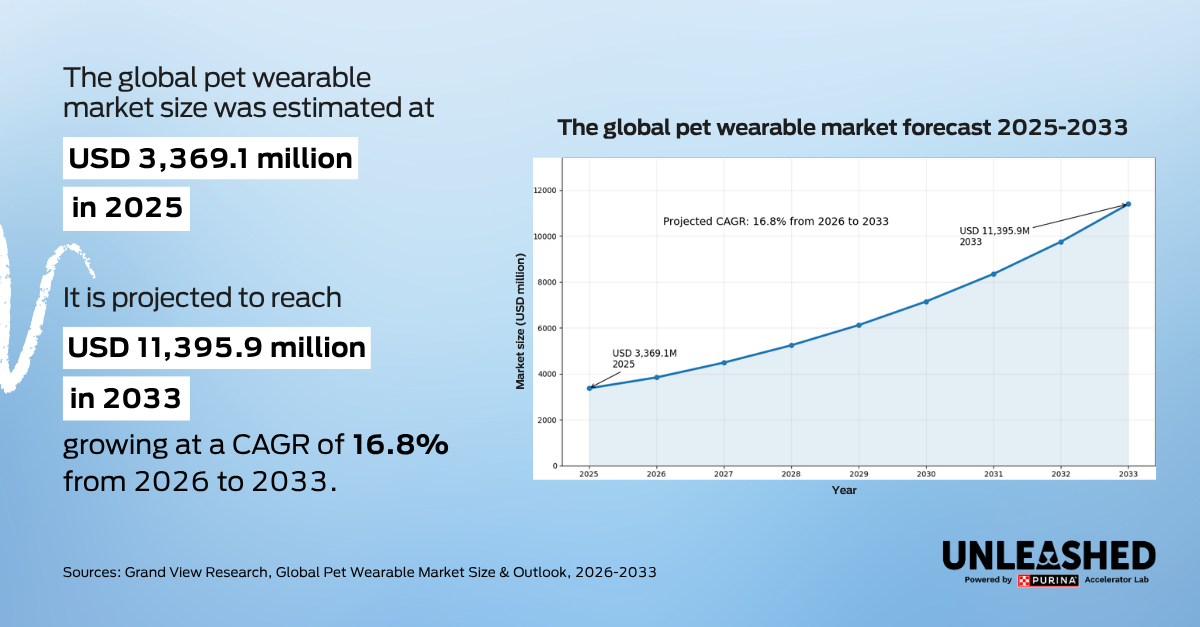
The global pet wearable market size was estimated at USD 3,369.1 million in 2025.
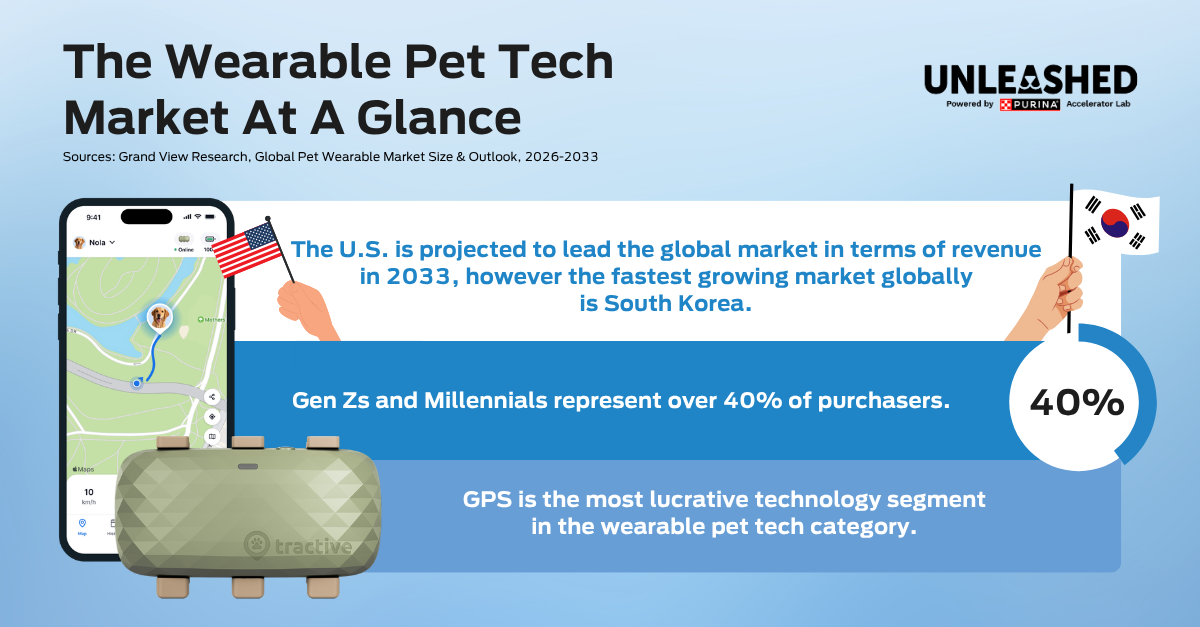
The US market accounts for 36.8% of that, followed by the EU and the Asian Pacific region.
Asia is particularly interesting in terms of pet tech, given the fast growing awareness in the region plus high tech adoption rates. This is why it’s predicted that, while the US will continue to dominate in terms of revenue, South Korea will have the fastest growing market for wearable pet tech.
In Europe, Germany leads the market with over 20% of the market share, though the UK is expected to see the fastest growth in the wearable pet tech space with an impressive CAGR of 16%.
And for a hardware product, investor interest seems to be more piqued than with other smart devices.
Garyth Stone, Managing Director at Houlihan Lokey said, “I see some of the accessories like automated feeders and so on growing, but remaining more niche than wearables. With a wearable, you're getting something you cannot get any other way; whereas an intelligent feeding bowl is still a feeding bowl”.
With the global market projected to reach USD 11,395.9 million by 2033, it’s hard not to share in Stone’s optimism for the category.

Where wearables win
As we’ve seen, the outlook is generally optimistic among the pet tech community for the future of wearables. One could argue that this optimism appeared most when wearable technology proved itself to be far more than a GPS tracker.
GPS-tracking
GPS-tracking collars were the natural first step in wearable pet technology.
With nearly 10 million cats and dogs going missing annually in the US alone, and similarly high numbers in other countries, there was an obvious need for tracking devices beyond just microchips.
From 2026 to 2034, the global GPS-tracking market for pets is expected to grow at a steady CAGR of 12.7%.
Available evidence suggests GPS trackers can help recover a lost pet, but published figures vary widely and are often based on vendor data rather than standardised trials.
Studies also show they are generally safe for consistent use.
That’s not to say that GPS trackers are infallible.
Yevheniia Korotka, Veterinary Health and Care Expert at PawChamp said, “I’m concerned about GPS in urban areas, as the signal can be unreliable. There can be a delay of between one and fifteen minutes, and when it really matters, that delay is felt very keenly”.
Health-tracking
In the early 2020s, we started to see popular pet tracker brands adding “activity monitoring” as a feature.
This mimics the human world, with the sudden spike in Fitbit culture and health metrics for optimisation.
While there’s evidence to suggest that activity monitoring is popular among pet owners, the veterinary community wasn’t so convinced.
Carolina Domingues (DVM), Senior Research and Partnerships Specialist at Maven Pet, told me, “A lot of consumer-facing pet technology focuses on generalised wellness trends or activity summaries, which can certainly increase engagement, but are not always actionable in a veterinary context”.
The tech has advanced rapidly, and we’re now seeing pet health monitoring expand beyond activity tracking with far more sophisticated metrics across connected devices. A recent published study reported how the Petivity Smart Litter Box Monitor could help detect behavioural changes related to chronic kidney disease, a common and serious health issue in older cats that’s irreversible and often challenging to detect, especially in the early stages of the disease.
Wearables are also beginning to demonstrate clinical utility for specific health metrics that matter to veterinarians.
“Resting respiratory rate is a strong example. In dogs with cardiac disease, particularly those at risk of congestive heart failure, changes in resting respiratory rate are one of the earliest and most clinically validated indicators of decompensation”, said Domingues.
Promising. And there are far more ailments where metrics from wearables could help.
Carolina Domingues, from Maven Pet, gave me a few examples:
“Dermatological conditions are another promising area, especially when it comes to tracking scratching, licking or restlessness longitudinally. In these cases, wearable data can help quantify severity and treatment response in a way that has traditionally been difficult to measure objectively”.
“We have also seen strong utility in osteoarthritis and chronic pain management, where subtle behavioural shifts often emerge long before owners recognise obvious mobility issues”.
Dr. Ragen T.S. McGowan, Global Director of Pet Technology Development at Purina mentioned other potential uses:
“While activity monitors are often used to track the physical activity of dogs participating in weight loss plans, there has been some work on classifying the difference in movement patterns between healthy and obese dogs as a means to understand whether smart dog trackers could actually be used as a tool to predict the onset of obesity.”
“Another topic of interest is the use of smart dog trackers to aid in the monitoring of seizure prone dogs. Several authors have set out to assess the efficacy of using activity trackers to monitor and perhaps predict seizure patterns. While most of this is still in early stages, this could be a game changer.”
The long-term use of these devices is particularly interesting for vets, as pets are living longer than ever before.
Yevheniia Korotka, Veterinary Health Expert from PawChamp said, “Wearable devices are most effective for older pets and those with existing chronic conditions: any change in activity levels or breathing at rest can be an early warning sign of a decline in health, allowing us to take action before the dog’s condition becomes obviously serious”.
However, experts have warned that an overreliance on or hypervigilance over these health markers could lead to at-home diagnoses or delayed action.
Dr McGowan said, “Devices are not diagnosticians. They are pattern detectors. A trend in data doesn't tell you what is wrong — it tells you something may have changed, and it's worth looking at. The clinical interpretation still lives with the veterinarian.”
Data centres
Big data was a buzzword around 2020. Now, it’s the backbone of many tech businesses.
With giants in the space like Tractive reaching over 1 million customers worldwide, these companies have amassed countless data points on the activity and health markers of pets at various ages, breeds and sizes.
Dr McGowan told me how Purina approaches data integration:
“We build the artificial intelligence and pet expert logic that make Purina’s pet IoT devices (Petivity), in-home health kits and recommendation engines smarter. We like to say we are creating products that give pets a voice and empower pet owners with knowledge to keep their pets healthy and happy.”
The power of this data could impact multiple other categories in the industry. Perhaps the most natural step is for data integration with veterinary PMS systems.
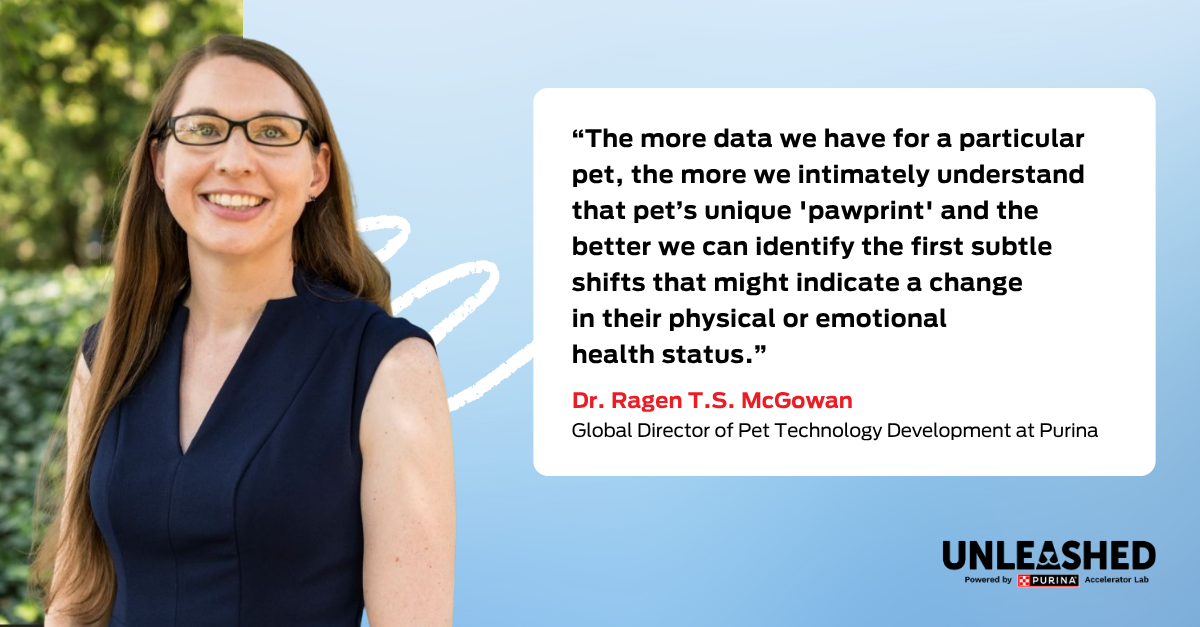
“The more data we have for a particular pet, the more we intimately understand that pet’s unique 'pawprint' and the better we can identify the first subtle shifts that might indicate a change in their physical or emotional health status”, said Dr McGowan.
Similarly, there is a great case for sharing this data with pet insurance companies, where better comparative and individual data can be used for allocating insurance premiums.
Where wearables struggle
It’s clear that the utility and capabilities of wearable technology is expanding and the category is growing. But this doesn’t guarantee that a wearable startup will get a seamless ski jump to unicorn status. There are two core challenges the category needs to address.
The adoption challenge
In the beginning of this article, we outlined some pretty impressive growth trajectories for wearables according to data projections.
However, it is this writer's opinion that the true adoption curve may be slower than the data suggests.
Why? One word: awareness.
GlobalData's 2025 UK Insurance Consumer Survey showed that fewer than 30% of pet owners surveyed were using smart devices to monitor their pets, although around 40% say they would consider doing so.
Andrew Bleiman, Executive Vice President of Tractive, North America said, “The last time we did our research on awareness of GPS pet trackers in the United States, only 5% of pet parents were aware of the existence of these types of solutions”.
And Tractive is one of the global leaders for pet trackers. That levy is hard to bridge but more promotion among veterinarians plus the more tech-savvy generation of Millennials, GenZ and Gen Alpha may usher in a new wave of interest in wearable devices over the coming years.
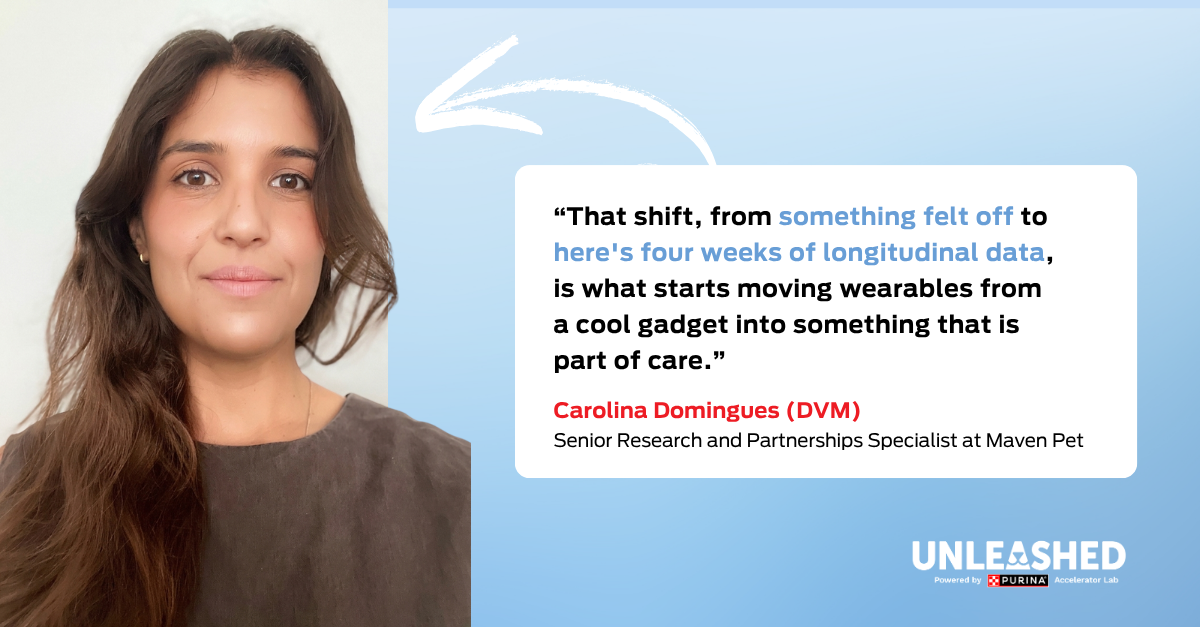
Carolina Domingues (DVM), Senior Research and Partnerships Specialist at Maven Pet said, “The industry is reaching an inflexion point where continuous monitoring is becoming less of a novelty and more of a standard expectation in preventive care”.
Beyond health care, there’s also a strong case that wearable tech could help owners foster closer bonds with their pets. Perhaps this is the angle that could increase adoption overall.
Dr. Ragen T.S. McGowan, Global Director of Pet Technology Development at Purina said, “We hear time and time again from pet owners that they want reassurance that they are doing the right things to keep their pets happy and healthy. For many, this means turning to technology as a means to better track their pet’s wellbeing. Smart technology is one way to empower them with data to be the best pet owner that they can be”.
The cat challenge
Despite sources suggesting that cats are several times more likely to go missing than dogs, adoption of cat tracking collars trails dogs by quite some margin globally.
It makes sense. Dogs are used to wearing collars, whereas many cat owners remark on how their cats feel less at ease with them. And that’s just the regular collars.
Add to that the weight of the tech needed to encase the sensors and SIM cards and your cat may well revolt as soon as you put the collar on (speaking from experience).
This may be less of a concern in cultures where cats are primarily kept indoors. A recent study showed that 57% of North American cat owners keep their felines at home. Legislation in Western Australia has also been introduced to prevent cats from roaming.
However, in Europe, where indoor-outdoor cats are more common, the cat segment of the wearable tech market overtakes dogs in terms of revenue and market share, with owners citing their cat’s natural roaming ways as a need for wearable tech.
As the tech improves, there’s hope that it’ll get small enough to be less cumbersome for small animals like cats, ferrets and miniature dogs, leading to higher adoption rates worldwide.
The future of wearable tech
So is the hardware curse finally broken?
Not yet, but wearables have a clearer path through it than any pet tech category before them.
The ingredients are there; clinically validated data, a growing roster of veterinarians treating devices as trusted diagnostic allies rather than a passing fad and a market still (mostly) unaware of what's already possible.
That gap between capability and awareness is where the next wave of growth will come from.
The winners in the wearable category will be the ones that turn data into something a vet can act on, and an owner can trust without outsourcing their instincts entirely.
Smaller, smarter, less cumbersome hardware will solve the cat problem for owners of outdoor cats. Better integration with PMS systems and insurers will solve the relevance problem.
The final challenge is the harder one: convincing the other 60-90% of pet parents that wearable tech isn't just a gadget. It's care.
Written by Olivia de Santos, Pet Tech Writer @ Unleashed by Purina.