
How does a pet GPS-tracker born in one of the smallest countries in the world become a global leader in pet tech?
Tractive’s tale is far from an overnight success story. From their humble beginnings in Austria, they’ve spent over ten years building the world’s leading GPS and health tracker for pets.
And they did it so successfully that they achieved a landmark exit to Bending Spoons in April 2026.
So, how did they do it (especially in a landscape where investors often warn against the scalability of hardware tech)?
We spoke to Andrew Bleiman, Executive Vice President of Tractive, North America, to learn more about where it all began.
A simple idea in a small world
Our story begins with the first Michael: Michael Hurnaus. Growing up in Upper Austria, Hurnaus got the opportunity to move to the US in 2007 to work with Microsoft on the very first Surface tablet.
From there, he moved to Amazon where he worked on the first Kindle Fire.
Over the years, he grew a deep understanding of how independent devices work and loved developing the technology for tech giants.
There was only one problem: he missed home, and there weren’t any opportunities for working on tech innovation back in Pasching.
But Hurnaus returned anyway, eager to put what he had learned at Microsoft and Amazon to work in Austria.
The idea of Tractive sparked for Hurnaus during his time in Austria, when his friend’s dog went missing, and the community had great difficulty finding it.
It would be simple—a GPS-tracking collar that would help you locate your dog anywhere in the country.
Hurnaus enlisted the help of two more Michaels—Michael Lettner and Michael Tschernuth—to build the first prototype and put it to market.
They launched the first device as a Hardware as a Service (HaaS) product, which would be one of the main contributors to its early success.
Andrew Bleiman told me, “The device has a SIM card, and data connectivity is something people recognise comes with an ongoing cost. So, unlike many other hardware businesses, Tractive was fundamentally also a subscription business”.
Seeing the device’s unusually strong earning potential for a hardware product, angel investors provided the first layer of capital from 2012 to 2016. However, the bulk of Tractive’s growth came from good old bootstrapping and sweat equity.
As Tractive gained traction (no pun intended) in the early 2010s, naturally, the three Michaels started to think further afield.

Going global
Now, starting a tech company in Austria was a challenge, but not unheard of.
Andrew Bleiman said, “They did have some local friends, mentors and success data points to look towards on the software side. Runtastic sold to Adidas in 2015, which was a huge achievement in the Austrian tech community”.
Selling for €220 million, Runtastic’s success laid out a blueprint for how starting in Austria could be a benefit rather than a hindrance.
Bleiman continued, “Out of the gate, the devices needed to work in a lot of different countries. Austria is a small place. People put their dog in their car, and they go to Germany, Czech Republic, Italy, Switzerland and so on. So the device needed to work with every country’s telecom provider”.
By 2015, Tractive was well established in the DACH region and spreading across Europe.
Then a successful Series A round, raising €35 million in 2021, was the impetus to tackle the largest market of all: the USA. Though it wasn’t quite as smooth as the founders had first envisaged.
Bleiman said, “[The founders] attempted to enter the US market a couple of times with modest exploratory efforts, but without success since there were market leaders with significant traction in the space”.
The US market is famously complex for pet tech startups to crack because of the maturity and fragmentation of the market. But Tractive’s interoperability with multiple telecom providers was a silver bullet.
“It was somewhat ironic that the devices from Europe worked with all the US providers, whereas our US competitors only worked with one”.
Bringing a top-tier product and onboarding a local team made all the difference when Tractive finally entered the US market in 2020.
Bleiman joined the Tractive leadership around this time after a strong tenure of pet tech experience having been in management at Furbo.
“The founders had a recognition that if they were going to really be successful in the US, they would benefit from local expertise who understood the challenges and opportunities around growth in the US and Canada. So they gave us a lot of autonomy. My joke was always that we were the semi-autonomous republic of the United States within Tractive”, he said proudly.
With a strong foothold building in both the EU and the US, Tractive’s next evolution was one that no one could’ve predicted.
From GPS tracker to health tracker
Tractive’s expansion into the US and Canada coincided with another major update of the devices: activity monitoring. With the prevalence and popularity of human activity tracking around 2020, it was no surprise that Tractive’s 200,000 customers—at the time—loved this update.
“We did see that pet owners really enjoyed the activity tracking stats. However, while these real metrics can help you care for your pet, they don't translate directly to the animal health community”, Bleiman said.
They could’ve stopped there. After all, Tractive never set out to be a medical device, and consumer satisfaction with the activity feature was a perfectly reasonable reason to keep it at that. But the R&D team took on the challenge to improve the devices further.
In 2025, they would make a breakthrough.
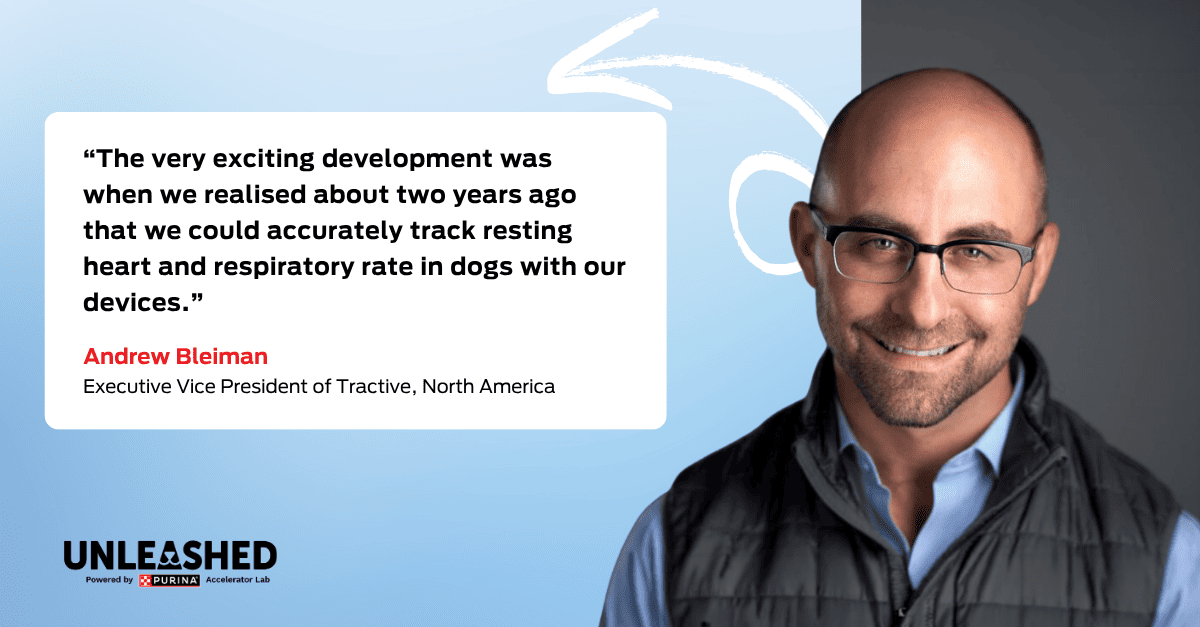
Bleiman told me, “The very exciting development was when we realised that we could accurately track resting heart and respiratory rate in dogs with our devices, with the sensors”.
Abnormalities in baseline resting heart and respiratory rates in pets have been proven to be reliable indicators of heart disease and other ailments. Tractive’s measurements over time would make it easier to track these vitals long term. This unlocked Tractive as not only an essential tool for pet owners, but a useful tool for vets too.
One could argue that the shift from GPS-tracker to health tracker prolonged customer loyalty tenfold.
“As pets get older, they run away less frequently. But that's also the time when pet owners shift to monitoring their health as they enter the second half of their life”, reflected Bleiman.
By the end of 2025, Tractive crossed that important metric of 1 million users. But what the rest of the industry didn’t know was that a landmark deal was brewing behind the scenes.
A new era
In May 2026, the Italian tech company, Bending Spoons, acquired Tractive. Having acquired many household names such as AOL, WeTransfer, Eventbrite and Vimeo, Tractive is the brand’s first pet tech acquisition.
When I asked what brought about this acquisition, Bleiman said, “Bending Spoons are excellent at innovation and growth of global tech platforms. I think we were very good in our space, but Bending Spoons really has the expertise to take it to the next level”.
So what’s next?
As the leadership team plan out their next frontier with Tractive, it’s clear to see that integration is a key part of the strategy, recently announcing multiple partnerships with pet insurers across the globe, lending credence to the idea that wearables could be gamechangers in the broader data landscape in the pet tech world.
“One of the places I'm most excited to see integrations put to work is with the PMS platforms for veterinarians. In a world where we didn't have a heart rate and respiratory rate, activity and sleep weren't as material. Now we can make a difference in animal health with that data”, said Bleiman.
A key challenge to tackle is consumer awareness, which is a hurdle for the pet wearables market as a whole.
In the age of a more discerning pet parent and more cautious investors, Tractive’s story shows that the basics still work: a great product, a globalised outlook and a fundamental drive to make pets’ lives better.
And as AI and integrations grow in our industry, it will be interesting to see where Tractive goes next.
Written by Olivia de Santos, Pet Tech Writer @ Unleashed by Purina.