![Quote graphic: “We learned that there was a gigantic gap between what [vets] wanted and what existed in the market across the world. So we decided to build the solution.” Nicolò Frisiani, CEO and Co-founder of Lupa](/sites/default/files/2026-04/2_UNL_BLOG_LupaInterview_600x400.png)
How do you solve a problem like a pet entrepreneur?
From the founder stories we’ve highlighted in the past, a common pattern emerges:
A passionate pet owner notices a bugbear in their day-to-day life and creates a product to fix it. This is an absolutely valid way to start and grow a successful pet company.
However, as former consultants, the Lupa Pets founders focused on solving a real problem in the veterinary community: simplifying the admin that drowns us all.
This is the story of three friends putting their talents together to create a company whose meteoric growth is surprising us all.
I sat down with the co-founders of Lupa, Nicolò Frisiani, CEO, Matei Bjola, COO, and Raúl Lozano Martin, CTO, to learn more.
Starting with the end in mind
Lupa was born from a market-first approach.
Nicolò Frisiani told me, “Matei [Bjola] and I were working at a consulting firm. One of the clients they had was a private equity fund that owns a huge veterinary chain. Through working with them, we learned that there was a gigantic gap between what they wanted and what existed in the market across the world. So we decided to start building the solution ourselves”.
That’s when Nicolò and Matei reached out to former Meta engineer and long time friend Raúl Lozano Martin, to spearhead a tech solution that could help veterinary clinics run more smoothly.
So what did they build? An AI-powered veterinary operating system to help run the operations of a veterinary clinic from top to bottom.
Nicolò explained, “We cover medical records, appointment management, invoicing, inventory management and communication with the pet owners. And this is not just for the individual clinic, but rather set up to work at an enterprise level for veterinary chains”.
Once they had a viable product on their hands, crafted with Raúl’s expertise, Matei and Nicolò hit the streets of London, prospecting veterinary clinics about this simple, yet highly effective, piece of software that could optimise their workflows. That was 2024. Word spread. Reputation followed. And soon enough, investors were knocking on their door.
Tech-led, design forward
At this point in the story, I started to wonder about one thing: the viability and future of AI.
With the “bubble” word being thrown around a lot recently, and many new AI PMS companies popping up across the globe, what differentiates Lupa from the rest?
The answer was twofold.
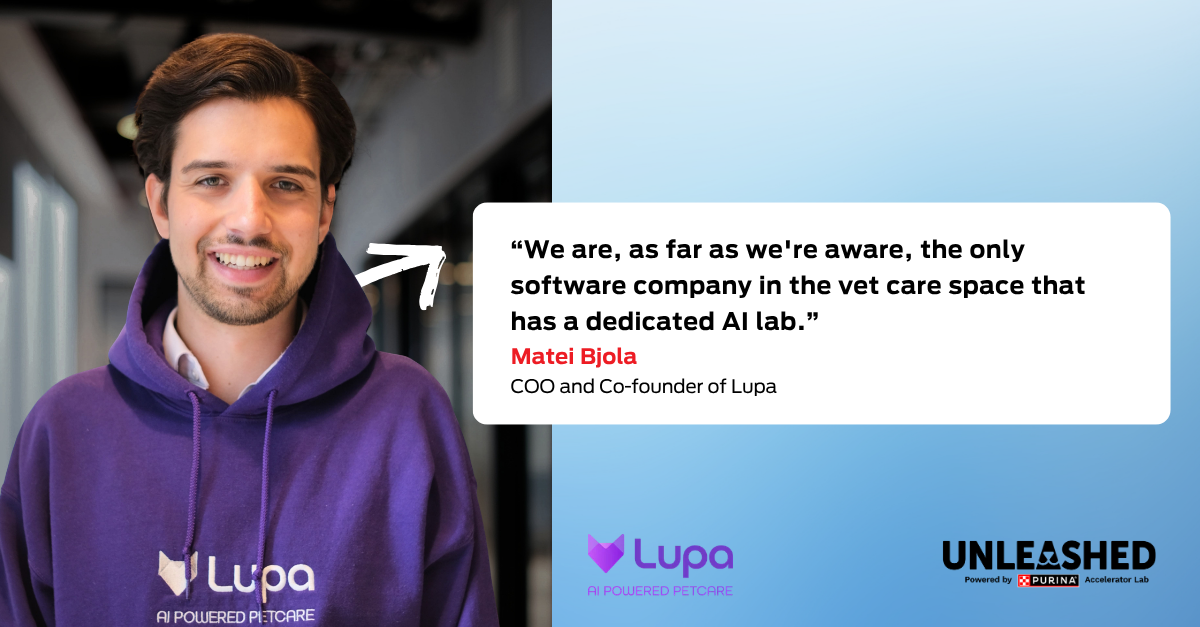
“We are, as far as we're aware, the only software company in the vet care space that has a dedicated AI lab. With a number of researchers, software engineers that do nothing else, but research, experiment and then build applications that can help bring AI into the day-to-day of veterinarians”, Matei explained.
Indeed, having a dedicated team for the development and improvement of their AI applications could help the Lupa team outrun the competition. The British Veterinary Association (BVA) revealed in a recent survey that over a fifth of British vets are already using AI as part of their workflows. Therefore, it stands to reason that AI is not just a buzzword for the vet care community, but more of a new tool they are eager and willing to explore.
While the technology itself is exciting, the second differentiator was what really stood out: seamless integration.
“We think that AI will only really be adopted in clinics if it's natively embedded in the workflows of the veterinarians”, said Matei.
This sentiment echoes what we discovered vets are asking for in our ‘AI in vet tech’ investigation in late 2025. With burnout being among the highest reported in the healthcare space, long onboarding processes would hinder a vet’s already intense workflow.
In line with ease of use, one aspect that, I’d argue, is one of their strongest selling points, is the UX of the platform. The Lupa team have completed something that many fail at: creating a B2B product that is as good-looking as it is functional.
When I asked Raúl about their approach to design specifically, he said, “We’re always asking: how do we make it as simple as possible to use? It starts with having very strong UI components, and then we track all the user interactions with the different buttons in the pages”.
So, real-life user data and feedback is used to continually improve the user-friendliness of the software. What Raúl calls “abstracting the complexity” from the end user.
Nicolò added, “We try to build a tool for businesses as if it was a tool for consumers. Consumer tech is always so good for user experience, while business tools have always been a bit neglected. If you don't give a vet a tool that competes with what they usually have on their phone as a consumer tool, they will hate it”.
Though the founders initially considered bootstrapping, they realised that developing their tool would take top-tier engineering talent. Lupa secured their first injection of seed capital in 2024, and it was off to the races.
The growth spurt
Despite Lupa being a young company, their growth curve has been one of the steepest we’ve seen in the pet tech world. From 25 clinics in 2024, to 250 clinics in 2025, it begs the question: how did the Lupa team achieve such a sharp adoption incline?
A large part of that growth has been driven by strong branding and word-of-mouth. Veterinary clinics, often tightly networked and recommendation driven, became Lupa’s most effective distribution channel.
Matei explained, “Having a phenomenal product that just looks nice at first sight really helps! I can't stress the importance of having a nice-looking piece of software that vets get excited about as soon as they see it”.
Alongside this organic traction, the team maintained a highly focused go-to-market strategy, targeting multi-site clinics and enterprise groups where the operational impact of their software would be most immediate.
“We've built very strong partnerships with buying groups, with diagnostics companies, with pharmaceutical companies and so on. We're also very lucky to have a strong network within the enterprise groups”, said Matei.
Just as importantly, they built in constant feedback loops from day one. That made clinics more than just customers; they were collaborators, shaping the product in real time.
This combination of strong product-market fit, targeted outreach and continuous iteration made Lupa an attractive prospect for investors, allowing them to secure funding relatively quickly and accelerate their growth further.
But like any growth spurt, it’s not without its challenges, and this article wouldn’t be complete without recognising them.
For Lupa, the biggest constraint hasn’t been demand. It’s been finding the right team to meet that demand.
Raúl explained the trickiness of finding the right team on the tech side.
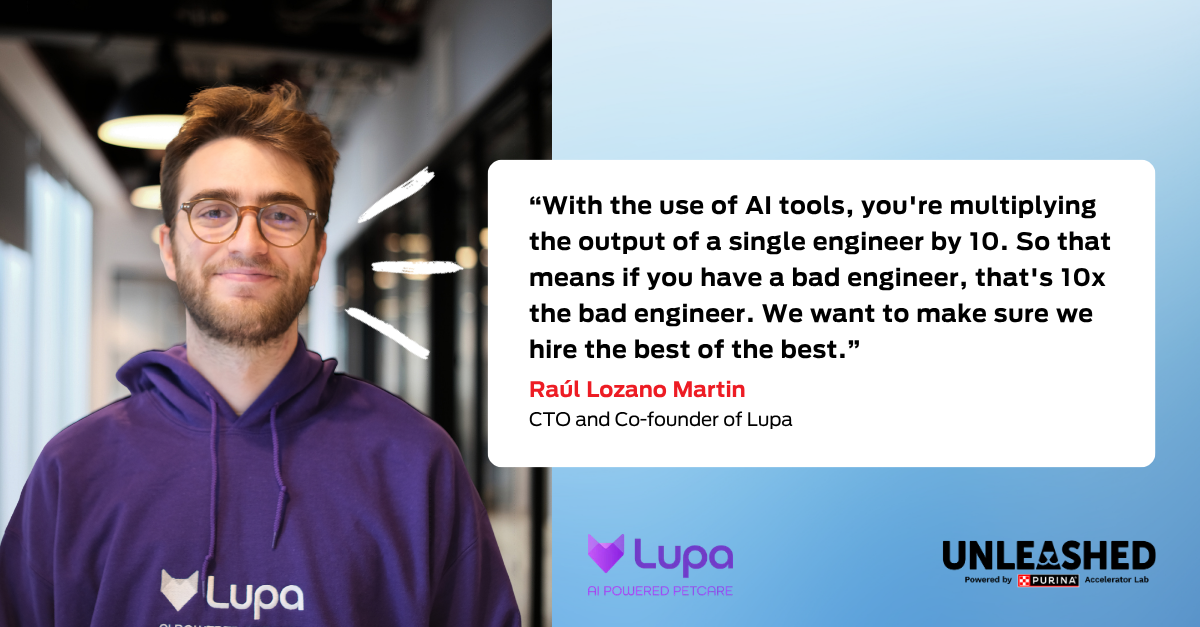
“With the use of AI tools, you're multiplying the output of a single engineer by 10. So that means if you have a bad engineer, that's 10x the bad engineer. We want to make sure we hire the best of the best”.
Nicolò echoed those sentiments, highlighting their intense hiring processes. He said, “For the first two engineers that we hired, I did 350 interviews. I've been really happy with the result - the team is phenomenal. It's probably our biggest selling point”.
As the company scales, maintaining that balance between speed and quality remains one of their key priorities.

What’s next for Lupa?
“What’s next?”
This is often a complex question for young tech companies, but the founders have a crystal clear vision, starting with dominance in the UK vet space.
In the short term, their focus is on deepening their presence in the UK, with over 1,000 veterinary clinics already in their pipeline.
“In order for us to build the generational company we want to build in the animal care space, we can't stay focused just on the UK. We need to branch out, and we want to do so at a calculated and yet aggressive pace”, said Matei.
Expansion into the US and DACH markets is firmly on the horizon.
“We're launching our first collaborations with clinics in Germany and the US this quarter”, Matei continued.
At the same time, they’re continuing to invest heavily in their team and AI capabilities - doubling down on the very elements that set them apart in the first place.
If their early trajectory is anything to go by, Lupa is positioning itself as a foundational layer in the future of veterinary care. With many vet tech companies fighting for that spot, Lupa seems uniquely primed to dominate, and we can’t wait to see what they do next.
Written by Olivia de Santos, Pet Tech Writer @ Unleashed by Purina.