
The pet boom of 2020 to 2024 was our industrial revolution.
Pet adoption increased rapidly. Everything ‘pet’ was destined for exponential growth.
Per pet spend skyrocketed, and a new wave of pet parents stepped into their spending power.
Six years on, the pet industry has changed but more subtly. It’s maturing alongside those new pet parents.
Today, we have time-poor consumers, pets living longer than ever, and a market whose tastes have sharpened over time.
I sat down with Garyth Stone, a Managing Director at Houlihan Lokey, Sophie Luck, Principal at JamJar Investments and Clément Helinckx, Principal at DLF Venture, to understand what investors are excited about in this new age of the pet world.
The state of the pet industry in 2026
The global pet care market is holding strong, and forecasted to grow from about USD 243 to 250 billion in 2025, to roughly USD 480 plus billion by 2035; a compound annual growth rate (CAGR) of around 7%. Premiumisation and humanisation are the key drivers of growth, with Millennials and Gen Z treating their pets like integral members of the family and spending more on them than ever before.
That said, we’re in a new era of pet parenthood, where discernment is shaping the market.
Sophie Luck said, “We’re reaching phase two of premiumisation now, where it's not just a more premium offering for the sake of it. It's about premium with proof”.
This means ‘clinically tested’ and ‘vet-approved’ products are more popular than ever.
We’ve also seen a migration back into the office post-pandemic, which has left the new generation of pets alone at home. This has brought convenience and pet wellbeing into focus for the latest innovations in pet care. In this vein, personalised recommendations by breed, age and other factors make purchasing choices quicker and simpler.
Finally, the move towards preventative care and longevity mirrors that of the human world.
Garyth Stone said, “I see a focus on preventative rather than curative health as a continuing trend, which not only affects food but also supplementation, wearables and so on”.
These shifts help explain why the categories attracting the most attention today are those that deliver on convenience, credibility and long-term health.
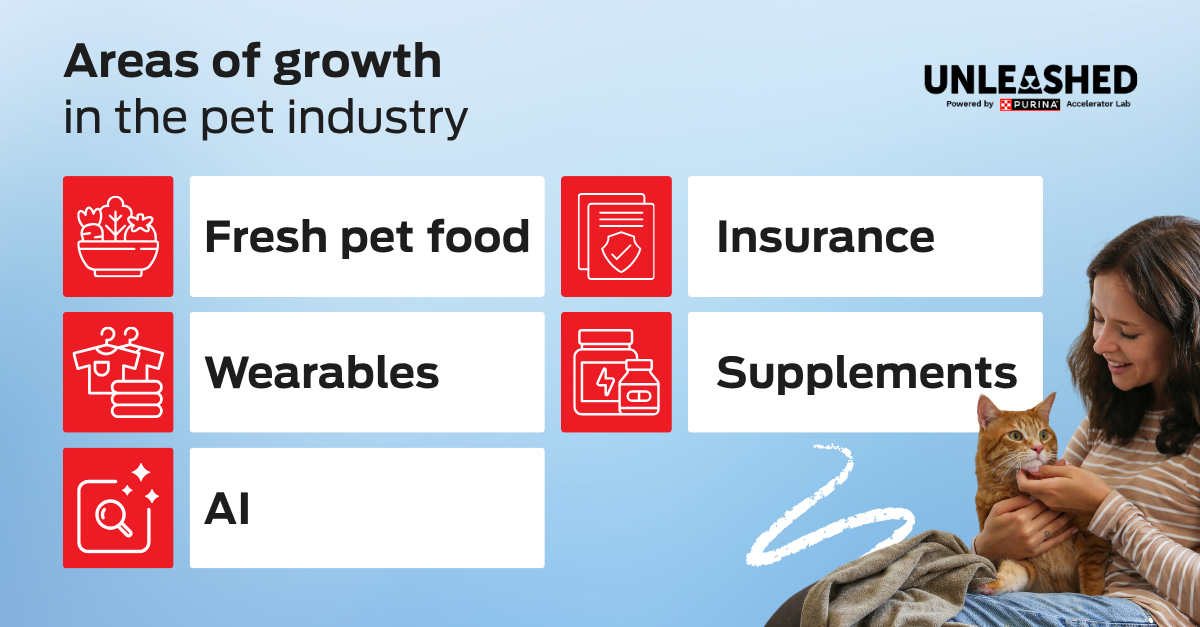
Where innovation is accelerating
Though in investors’ eyes we may be reaching a maturation point in the pet care industry, there are still plenty of areas where innovation is flourishing. Here’s what the experts say:
Fresh pet food
Fresh and raw pet food have been popular for over ten years, but it’s fair to say that the category has reached an inflection point for rapid growth.
According to Reports Insights Consulting Pvt Ltd, The Europe Fresh Pet Food Market is projected to grow at a CAGR of 18.5% between 2026 and 2033, reaching an estimated USD 6.2 billion in 2026 and is projected to grow to USD 24 billion by 2033.
We can see this shift at the micro level too, with Butternut Box in the UK and Farmer’s Dog in the US reaching unicorn status in their respective home territories.
Garyth Stone recounted the success story of Prime 100, a fresh pet food business in Australia.
“I sold Prime 100 in Australia a couple of years ago that was growing exceptionally well. They have a significantly higher penetration there. So there's no particular reason to believe that fresh, chilled fresh or frozen fresh couldn’t get to 15 to 20% of the market in North America or Western Europe”.
Some estimates already place the US market at 16% penetration, and is projected to grow by USD 3.2 billion in value between 2025 and 2029.
The ‘healthy’ and ‘clean’ branding of these products appease the modern pet parent, where health, wellness and longevity are top of mind.
However, despite the popularity of fresh food products among consumers, there’s always been multiple hindrances to its growth, including storage, delivery and convenience.
Sophie Luck told me, “I would say in the last 10 years in food, as an example, fresh and raw pet food became more of a thing. Whereas now, the question becomes: how can we get the benefits of some of those innovations, but make them way more convenient?”
Enter ‘pantry fresh’ or ‘ambient fresh’. In other words, fresh style pet food that doesn’t need to be chilled or frozen. Innovation here unlocks one of the key friction points that could skyrocket their category’s dominance in years to come.
Wearables
Similar to the humanisation of pet food, wearables are piquing the interest of ‘high worriers’ that want to optimise and track their pet’s health.
And this is not just a US story. The pet wearable tech market in Europe is expected to reach a projected revenue of US$ 3,252.6 million by 2033, with Germany, France and Spain being particularly active markets.
Garyth Stone said, “The tech is becoming smaller, lighter and more efficient, and that's driving adoption very significantly”.
So it’s no surprise that the sector’s standout, Tractive, announced their exit to tech company Bending Spoons in Q2 2026.
As the engineering advances and AI furthers data analysis, signals point towards wearables dominating in the pet tech sphere more than smart gadgets like autofeeders (but we’ll come back to that later).

AI
Speaking of AI, no industry is immune from the dominance of LLMs in people’s daily lives. As Googling turns into ‘asking Chat’, there has been both celebration and trepidation among pet care experts about the impact of AI.
That said, the innovation in the space is exciting to behold. From AI-powered clinical tools to more practice management support, vet tech is being influenced the most.
As part of our accelerator programme, we’ve supported multiple AI-based vet tech solutions, including AI FOR PET and AITEM.
The proposition is gold; however, the world is yet to see a breakout that can generate consistent revenue.
In our deep dive into AI in vet tech in 2025, we spoke to industry experts who mentioned the validation of clinical data being the primary concern for clinical use.
Amanda Boag, from the Royal Veterinary College, said, “I think there is much more concern around the clinical support tools, the quality of those tools and how they could impact on animal welfare if they weren't well validated”.
But within the data conversation lies another exciting opportunity for innovation, with the support of AI: data integration.
Garyth Stone said, “You can use a combination of AI plus health tracking apps to do diagnoses remotely that avoid the need for physical vet visits, preempting ailments and can, therefore, reduce vet bills for insurers and bring insurance premiums down. That concept is super exciting, but still very nascent”.
Insurance
The rise in pet insurance has been a surprise to many of us in Europe too. Given that health insurance is more niche among Europeans, the pet insurance market is flourishing with a market size estimated at USD 8.7 billion in 2025 and is projected to reach USD 25.9 billion by 2033.
While premiumisation and humanisation are key factors here, a more consistent driver of growth has been the rise in veterinary fees, with some countries such as the UK calling for structural reform and regulations.
The UK dominates today, but Germany, France, Italy, Spain, Benelux and Nordics are all highlighted as growth markets, with new insurtech embedded, and bancassurance channels widening access among the general population.
When wearable technology and insurtech begin to communicate with one another, this will improve health insights for vets and pet parents alike. This specific area remains a wide open opportunity for innovation.
Supplements
Excitement about pet supplements has been around for some time.
Let’s look at the numbers.
The pet dietary supplement market is set to grow from an estimated USD 1,304.5 million in 2025 to USD 2,431.3 million by 2035, with a CAGR of 5.1%.
On a global scale, the market size was valued at USD 3.14 billion in 2025 and is projected to reach USD 5.47 billion by 2034.
Impressive. But there is still a gap in clinical data to back up the efficacy of some supplements and real-life use.
“It’s quite difficult for customers to understand what supplements their pets need, and how it complements pet food. There is also a lack of testing, and customers often believe that supplements could be a silver bullet for their pet’s issues”, said Clément Helinckx, Principal at DLF Venture.
There is also the convenience piece. A supplement treat requires pet parents to forge new habits.
Sophie Luck told me what type of supplements she thinks would win in this more discerning market:
“I would like to see that industry going more in the direction of being added to food. So more like a topper or powder that can be added to food during meals. Or really hardcore, almost pharmaceutical-level supplements with high levels of advocacy, novel ingredients and science-backed data”.
For example, Purina Pro Plan’s FortiFlora and Calming Care are clinically backed supplements with high efficacy.

Where innovation is slowing down
It wasn’t too long ago when everything ‘pet’ was selling well. But in 2026, pet parents are becoming more discerning with their dollar (or pound, or euro or yen…).
These categories may continue to grow, but may not excite investors.
Pet toys and apparel
From a pure numbers perspective, pet toys seem to be doing well.
One global pet toys report estimates the market will grow from about USD 3.52 billion in 2025 to USD 3.79 billion in 2026 and on to roughly USD 5.11 billion by 2030, implying around 7.7 to 7.8% CAGR.
Despite the rising cost of living globally, many pet parents are prioritising their pet’s wellbeing within their budgets. However, data shows that consumers are more likely to spend their money on essentials like pet food, rather than toys and apparel, which makes the sector vulnerable to market fluctuations.
As Clément Helinckx put it, “As investors, we want to make sure that we are supporting products that are actually useful”.
Plus, there hasn’t been much innovation in the pet toy and apparel space, given that the priority is low for the consumer and differentiation is difficult. (Will anyone displace the Kong toy as the reigning champion?)
While there will always be a market for toys and clothes, indicators suggest this will always remain a niche within our industry.
Smart pet gadgets
Autofeeders, autofountains and litterbots all tap into the high convenience culture we’re moving towards, appealing to the ‘busy’ pet parent archetype.
The numbers support that projected growth.
The global automatic and smart pet feeder market size accounted for USD 2.61 billion in 2025, growing to USD 2.90 billion in 2026 and projected to surpass around USD 7.56 billion by 2035, representing a healthy CAGR of 11.22% between 2026 and 2035.
But is that growth exponential?
Garyth Stone mentioned that he perceives automated gadgets as more niche than wearables.
“With a wearable, you're getting something you cannot get any other way; whereas an intelligent feeding bowl is still a feeding bowl”.
Similarly, Sophie Luck explained how the convenience piece may not be as straightforward as once thought. When a person chooses to adopt a cat or dog, they typically plan how feeding, toileting, watering and so on will factor into their daily routines.
She said, “[Using an autofeeder] is a big break of the routine versus a little break of the routine. And I think people might say it's subtractive as much as it is addictive”.
From the investor’s point of view, smart gadgets could remain a profitable niche over the coming years. A niche product can still be a large niche and generate millions. However, with the cost of production and per unit economics being so high, smart pet care startups could find it more challenging to justify their value proposition in a more discerning, proof-driven market.
What’s emerging next?
We’ve explored the accelerating trends and slowing ones, but what’s next on the horizon?
For our experts, two categories are sparking the most interest.
Pet services
Pet services such as pet day care, grooming, sitting, hotels and wellness services are far more popular stateside than in Europe.
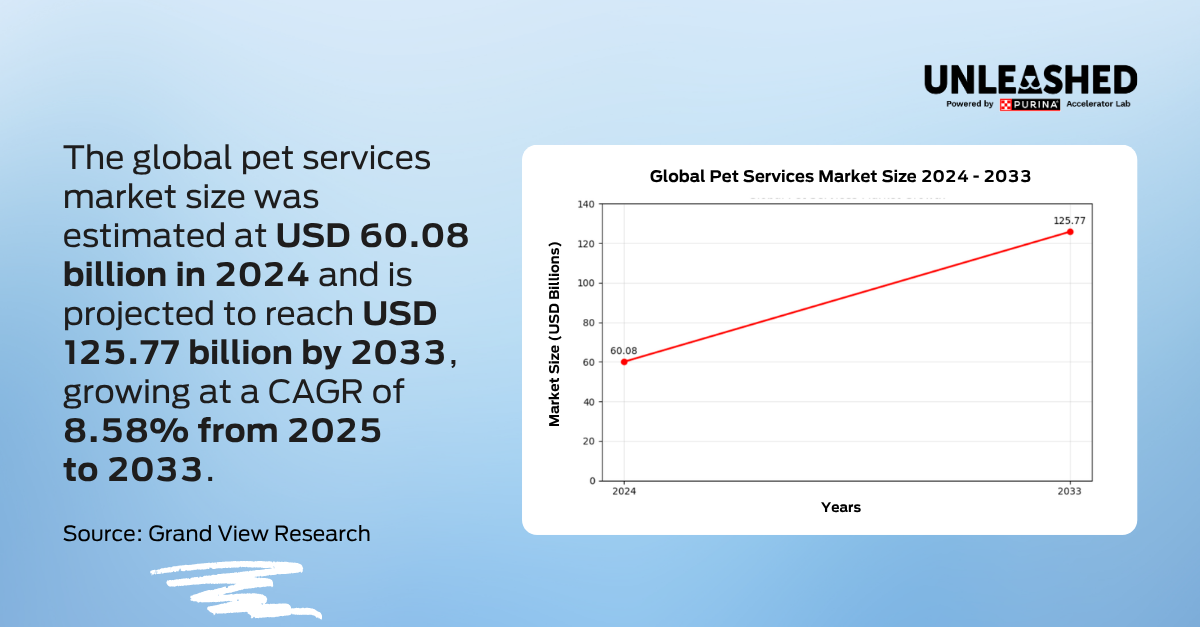
The global pet services market size was estimated at USD 60.08 billion in 2024 and is projected to reach USD 125.77 billion by 2033, growing at a CAGR of 8.58% from 2025 to 2033.
The European pet services market is projected to reach roughly USD 9.56 billion by 2030, accounting for a tiny slice of that global market share. Though, interestingly, the Asia-Pacific region is the most dynamic market for pet hotels, specifically due to rising disposable income.
With giants like Rover rapidly expanding across Europe and innovations within health and wellness care, it’s piquing the interest of investors.
Sophie Luck said, “I have been a bit more excited to see health services that cater to dogs that are either older or have some specific kind of hereditary health or illness issue. So, for example, I've seen a couple of decks around like dog physios”.
However, it remains to be seen how practical these services may be in the long term. Similar to smart gadgets, integrating pet services into your routine as a pet parent requires a change in habit. So any innovations within this space must account for the convenience of the middle-income pet parent in order to see exponential growth and investor interest.
Novel ingredients
Another exciting area for innovation and growth is the novel protein sector. This area has had varying success in the human food market, with former giants in the space, Beyond Meat, losing 99.7% of its value since 2021.
That said, investors are more confident about its potential in the pet food industry due to a softer barrier to entry and (potentially) a more willing consumer.
Let’s take insect proteins, for example. The global insect protein market was worth USD 268.7 million in 2022, at an unimaginable CAGR of over 31.50%, it is projected that this figure will hit a whopping USD 4154.56 million by 2032.
And it’s fair to assume that consumers would be more willing to feed their pets food with insect proteins than to consume it themselves. In that sense, the pet category may act as a proving ground for alternative proteins before wider human adoption.
When it comes to cultivated meats, the precise baseline varies a lot by source, but everyone agrees on ‘a very small base, very high double‑digit growth’.
There are some exciting startups in this space, such as Unleashed by Purina alumni BlueNalu, who secured a partnership with NomadFoods in 2025 to pilot pet food products with cultivated seafood. However, it’s still early days for players in this space. If challenges around palatability, shelf life, production cost, scalability, market perception and regulations can all be addressed, novel protein innovation could transform the pet food industry - but that’s a big ask.

From boom to maturity
As the pet industry moves beyond its boom years, many have wondered if the opportunity would dampen. It hasn’t. It has simply evolved.
Growth is no longer driven by novelty alone, but by solutions that deliver on convenience, credibility and long-term health.
For startups and investors alike, the pet industry remains a resilient and attractive category, but success will depend on understanding a more discerning, better-informed pet parent.
At Unleashed, we continue to support founders building the next generation of pet care, grounded in these shifting trends. And we’re excited to see how the next few years will unfold.
Written by Olivia de Santos, Pet Tech Writer @ Unleashed by Purina.