
If you've read our articles before on the latest trends in the pet industry, you'll note that this writer rarely speaks from her perspective. And yet, as I type this, I'm in the emergency room with my dear ginger cat, Finn.
This typically jolly, sun-loving fluff ball is in my arms, crying in pain, while I review a vet bill I wasn't prepared for.
Of course, I will do anything to save him.
But it also occurs to me that emergency veterinary care has come a long way. Finn is getting treatment that simply wasn't available a decade ago. The bill, however, is significant, and his medical care has only just begun.
This is the exact scenario that makes a pet parent seriously consider the topic of today's article: pet insurance.
In the face of rising veterinary costs, more and more pet parents are turning to pet insurance for peace of mind when the unexpected happens.
There's no question about the utility. Pet insurance is a social good. But there’s a lot we could learn about this surprisingly lucrative yet nascent sector:
How can we educate pet parents about an accident before an emergency happens?
How are pet insurtech startups innovating to improve the customer experience?
And can data integration between pet insurers and veterinary services, wearable tech and other categories lead to better outcomes for pet parents and their pets?
To answer these questions, I spoke to Michael Thorpe, Managing Director at Correlation Risk Partners, Alban de Préville, CEO and Co-founder of Dalma, Alvaro Gutierrez Co-founder & Co-CEO of Barkibu, Alexandre Krief, Co-founder & CEO of Kozoo, Henri Dowling, CEO of Waggel, and Carl-Johan Nilsson, Country Manager Sweden at Lassie.
Here’s the real story behind why pet insurance is already a billion-dollar sector and where it’s heading next.
The state of the pet insurance industry
The global pet insurance market size has grown rapidly in recent years. It will grow from $10.66 billion in 2025 to $12.53 billion in 2026 at a compound annual growth rate (CAGR) of 17.6%.
But pet insurance is one of the most culturally specific sectors we’ve covered here at Unleashed.
A GPS tracker in Japan has the same function in Romania.
Pet insurance couldn’t be more different.
Europe
It’s somewhat superfluous to group Europe (or really any continent) together when it comes to pet insurance, because attitudes, availability, awareness, and, therefore, penetration vary so widely. That said, it is the region with the highest penetration and the largest market share.
The headline is that Sweden has the highest dog insurance penetration rate in the world. A whopping 90% of dogs in Sweden are insured.
The UK has the highest population of insured pets in Europe and owns the largest market share at 25-30%.
Third place is Germany with around a 20% market penetration. Their case is interesting as they are one of the few countries in the world with federal standardised vet pricing (Gebührenordnung für Tierärzte or GOT). Yet those prices rose by about 20-25% in 2022 leading to a surge in interest in insurance.
France sits at around 7-8% penetration, with the southern (e.g Spain, Portugal, Italy) and eastern (Romania, Hungary, Slovenia) European countries trailing by quite some margin.
North America
By sheer numbers, the US dominates the market, with around 6.4 million pets insured there by early 2025. More than a third of all insured pets in the US reside in just four states: California, New York, Florida, and Texas.
However, this accounts for less than 5% of all pets, meaning 95% of pets in the US are uninsured. Canada has similar rates.
You might think the concept of pet insurance would be an easier sell in the US, as human health insurance is a necessity. However, high pet insurance premiums, pre-existing condition exclusions, and overall customer confusion are key factors in why uptake is low.
These barriers are not unique to the US; similar dynamics play out in markets across the UK, Europe and beyond.
Asia-Pacific
The Asia-Pacific region has the fastest-growing market for pet insurance with a predicted CAGR of 17.82% from 2026 to 2033.
Countries such as China, India, and South Korea are growing more established veterinary care systems, making pet insurance an attractive prospect.
Australia has an established place in the market, representing 17.12% of the APAC pet insurance market size in 2025. However, it is currently dominated by one incumbent.
Michael Thorpe, Managing Director at Correlation Risk Partners, an investment firm with great expertise in pet insurance, said, “The Australian market is one that we've long looked at. It's dominated by one brand. Even many of their own brands are white label and underwritten by that brand. So the Australian market seems ripe for disruption.”
LATAM
LATAM has an emerging pet insurance market. The size reached around $970.47 Million in 2025, accounting for about 5% of the global market.
It is expected to grow to $2417.71 Million by 2034, with Mexico being the leader in terms of growth.
Middle East & Africa
Currently, the MENA region accounts for around 1-2% of the global pet insurance market share.
The UAE, Saudi Arabia and South Africa are the expected hubs for market growth led by growing awareness of pet healthcare.
South Africa in particular has a growing number of global and regional players entering the market, and a healthy expected CAGR of 13.2% from 2025 to 2033.
The growth drivers for the pet insurance sector
Rising global pet ownership and increasing veterinary treatment costs are the primary factors why pet insurance is growing so rapidly.
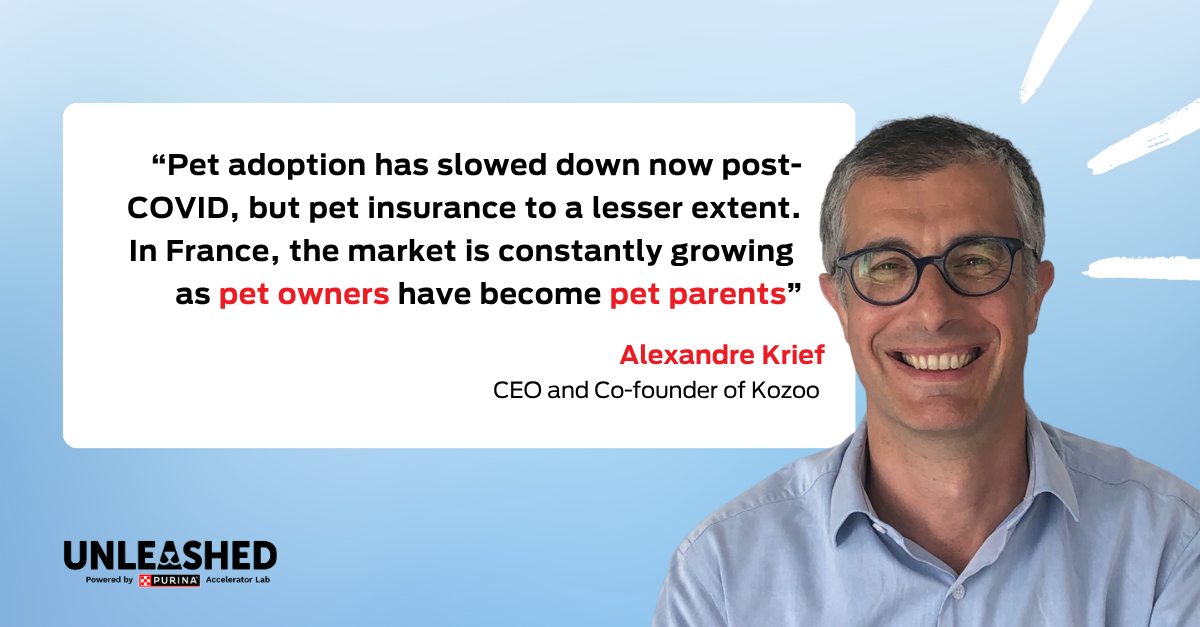
Alexandre Krief, Co-founder & CEO of Kozoo, said, “Pet adoption has slowed down now post-COVID, but pet insurance to a lesser extent. In France, the market is constantly growing as pet owners have become pet parents.”
This humanisation trend that we’ve seen over the past decade is driving especially younger pet parents to think differently about how they care for their pets. Though this will invariably shift as the market morphs and pets mature.
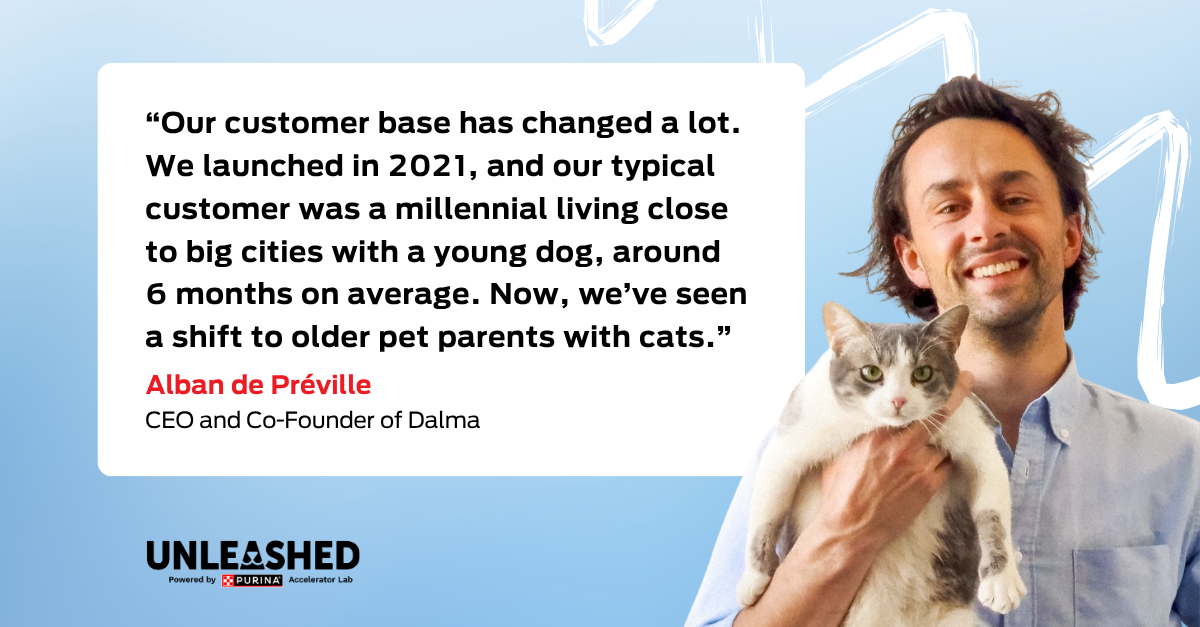
“Our customer base has changed a lot. We launched in 2021, and our typical customer was a millennial living close to big cities with a young dog, around 6 months on average. Now, we’ve seen a shift to older pet parents with cats,” said Alban de Préville, CEO and Co-founder of Dalma.
Because of the clear growth path for pet insurance, the sector is also becoming increasingly competitive.
Michael Thorpe, Managing Director at Correlation Risk Partners, mentioned, “Renewal rates are good. Low churn. Claims are relatively predictable. So [pet] is an attractive category if you get it right. But it has become increasingly competitive for all those reasons.”
Let’s now look at the ways that insurtech startups are tweaking the system to compete.
Advancements in the pet insurance sector
While old school insurers have been around for a while, the new school are inventing ways to approach pet parents with more transparency, simpler options, and a tech-forward approach.
As Henri Dowling, CEO of Waggel, put it, “One of our slogans since the early days is: pet insurance sucks, so we changed it.”
The predominant evolution I saw from speaking to these startups was the shift from accident and emergency to prevention.
Preventative care services
To some pet insurers, prevention, while promoted and championed, is slightly removed from the core purpose of insurance.
“[One] challenge is the confusion between prevention on the one hand, illness and accidents on the other. Insurance is designed to cover what is not predictable. Cover for preventative care like teeth descaling, vaccines, neutering, and so on, must remain an option alongside the core product which is illness/accident,” explained Alexandre Krief, Co-founder & CEO of Kozoo.
To other providers, prevention is the very fabric of the product.
Lassie, who brands themselves as a preventative pet insurance company, have turned pet care behaviours into rewards.
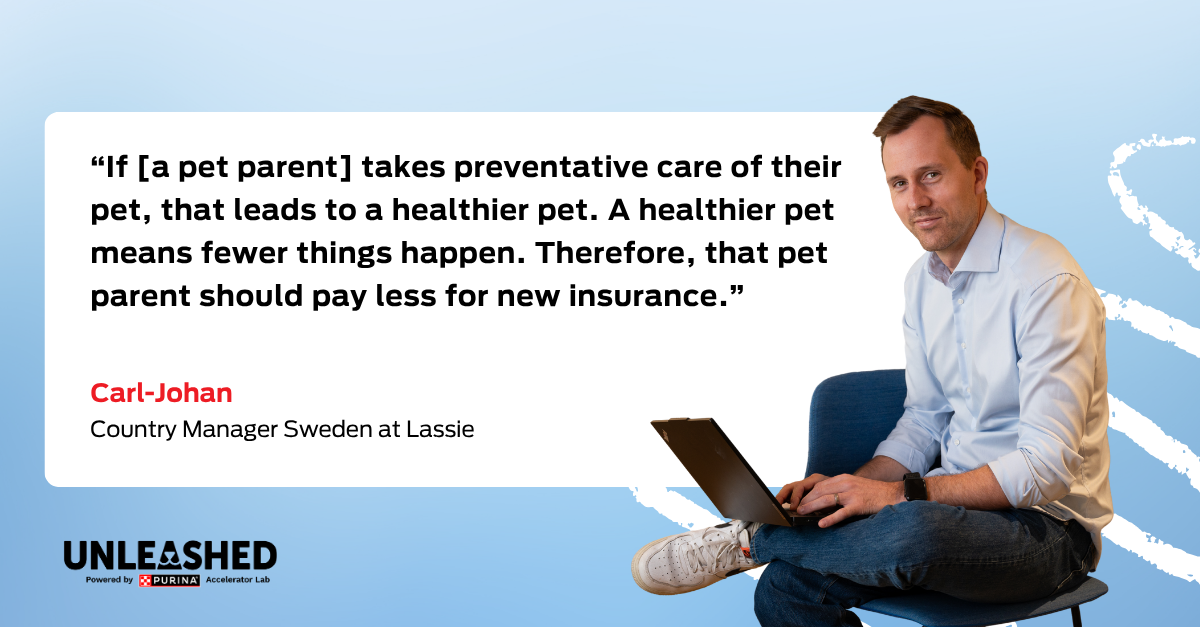
Carl-Johan Nilsson, Country Manager Sweden at Lassie explained, “If [a pet parent] takes preventative care of their pet, that leads to a healthier pet. A healthier pet means fewer things happen. Therefore, that pet parent should pay less for new insurance.”
But there’s also a commercial reason why preventative care focus could make sense for insurers.
If pet parents see pet insurance companies more as an educational pet care partner throughout a pet’s life, then this could create further opportunities for monetisation and growth.
Alban de Préville, CEO and Co-founder of Dalma, said “One idea could be to have your pet’s medical records directly integrated into our app. That would make the preventative health care content much more personalised.”
That said, adding a preventative component could introduce some complexity for insurers as cultures differ so much on pet care norms and veterinary guidelines.
“One reason is pet parent behaviour, but the second reason is that veterinary guidelines are different. For example, in Spain, the advice is to vaccinate against rabies every year. In Germany, many vets recommend every three years,” said Alvaro Gutierrez, Co-founder & Co-CEO of Barkibu.
Vaccination schedules can also vary by vaccine type and local regulations, adding further complexity for insurers designing cross-border preventative care products.
Having multiple approaches and offerings from accident and emergency to prevention is likely to be a net positive for the customer as they can choose their chosen path.
AI
AI is one of the most exciting areas for insurers.
All of the startups I spoke to handle a high percentage of their claims with the help of AI automation.
Barkibu has a complete AI operator. Alvaro Gutierrez, Co-founder & Co-CEO, explained, “We don't have customer service on the phone. All of our customers send the claims using the same app, and it gets analysed and resolved by the same AI.”
The result is lightning-fast claim reviews and therefore faster reimbursements. Carl-Johan Nilsson, Country Manager Sweden at Lassie, mentioned that over 50% of their claims are paid out in under five minutes.
However, even those with in-house claims teams still leverage AI for efficiency.
Henri Dowling, CEO of Waggel, described their approach as, “We want to use AI to help us be more human.”
Integrating AI workflows clearly represents an excellent opportunity for personalisation, speed, and a smoother customer experience.
Data integration
Depending on who you talk to, data integration between insurers, vets and even pet tech devices like wearables, litter robots and so on, is either a near-future reality or a far-distant fantasy.
Insurers are (probably) the best positioned in the pet market for huge pet health data collection, second to vets, of course.
Michael Thorpe from Correlation said, “Pet insurance has the benefit of being high volume and data-rich. With additional data sources like wearables, veterinary PMS (practice management systems), and even food, we can start to weave all of that in.”
Many of the pet insurers I spoke to have made alliances with other brands. For example, Dalma and Lassie have partnerships with Tractive. Kozoo have partnerships with Liv’ Vet and Inoxia, a French telehealth service and GPS tracking company, respectively. Waggel has deals with multiple UK pet names such as Biscuit, a pet care rewards app, and Trusted Housesitters, a pet sitting platform.
But here’s the problem. Is it possible to create a smooth flow of data sharing between vets, vet tech services, devices and pet insurers?
Henri Dowling, CEO of Waggel, pointed to an existing model in the UK's home and motor insurance sectors, where an independent company manages a shared claims database that all insurers can query at the point of claim, accessing only the relevant fields needed for verification. A similar initiative is emerging in the pet space, though limited to claims data rather than veterinary records.
"If a database existed that consolidated vet data, that would be even better," he said.
Sounds lovely. However, Alexandre Krief, CEO and Co-founder of Kozoo, raised an important point: “For every player, it's sort of fantasy to imagine having the whole value chain integrated in one mobile app. Technologically, it's quite easy now. But is there a real demand for that? It would make things easier for the industry players but does the customer want everything integrated?”
Alvaro Gutierrez, Co-founder & Co-CEO of Barkibu, echoed those statements, saying “We [pet insurers] are working in a market where a lot of our customers have trouble understanding the details of pet insurance. They don’t immediately understand why they need it and how it works. [Integrations] add complexity into their minds.”
And with a market that already needs coaxing into adopting pet insurance instead of relying on savings, might this added complexity make things even more confusing?
Challenges of the pet insurance sector
As vet prices (unfortunately) inflate further, there’s little doubt in my mind, or in the minds of industry experts, that the pet insurance market will naturally grow. However, there are a few key challenges facing companies in this sector as they scale and accelerate.
Raising awareness
Cast your mind to the regional differences section of this article, when I mentioned that Sweden has the highest percentage of insured dogs in the world, and the highest penetration for pet insurance overall.
This is because pet insurance awareness is so high, that it’s as natural as home or car insurance for them. Highly unusual for a non-compulsory insurance.
Carl-Johan, Country Manager Sweden at Lassie, told me, “In Sweden, most pet owners already have insurance, so our job isn't to educate people insurance matters; it's to tell them Lassie is the better choice. In our other markets, the challenge is different: we first have to educate the market on why insurance matters at all.”
And this is the major wrinkle in the expansion plan for pet insurance companies.
In places where the public health system is free and functional, many pet parents are unaware of the real costs of veterinary care.
Alban de Préville, CEO and Co-founder of Dalma, said, “In France, healthcare is very protected. We are not used to paying for health insurance, which also impacts the psychology around pet insurance.”
But it’s not just awareness of pet insurance that needs solving. It’s also transparency around veterinary fees.
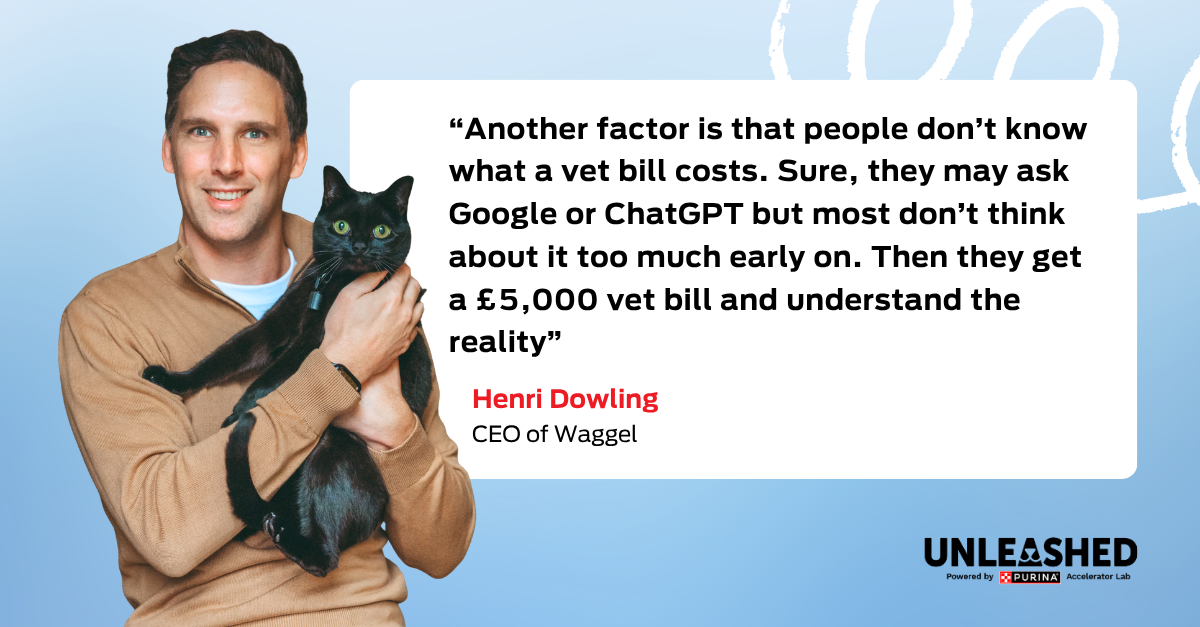
As Henri Dowling, CEO of Waggel, remarked, “Another factor is that people don’t know what a vet bill costs. Sure, they may ask Google or ChatGPT but most don’t think about it too much early on. Then they get a £5,000 vet bill and understand the reality.”
Therefore, the startup CEOs I spoke to often mentioned educating the market as a key part of their strategy, as so many need convincing. That said, many also mentioned that referrals and word-of-mouth are strong channels for them. So as more people adopt pet insurance, they’ll be more likely to spread the word among their circles.
Digital-first vs the human touch
We discussed AI as a force multiplier earlier. Yet, one decision that pet insurtech startups must make is exactly how much will be automated vs maintaining human customer service. After all, pet insurance is a highly emotional product for the customer.
To some extent, this is culture-specific. Michael Thorpe, Managing Director at Correlation Risk Partners, said, “[In certain countries], some people still really want human contact, like they have a broker where they go and speak to someone. Most pet insurance today is very digitally native. One element I think we've certainly experienced is how do you have a digital strategy, but also complement it with some human touch?”
Barkibu is the most radical in this respect, with 100% of claims being processed by AI with no personalisation or human interaction at any stage of the process.
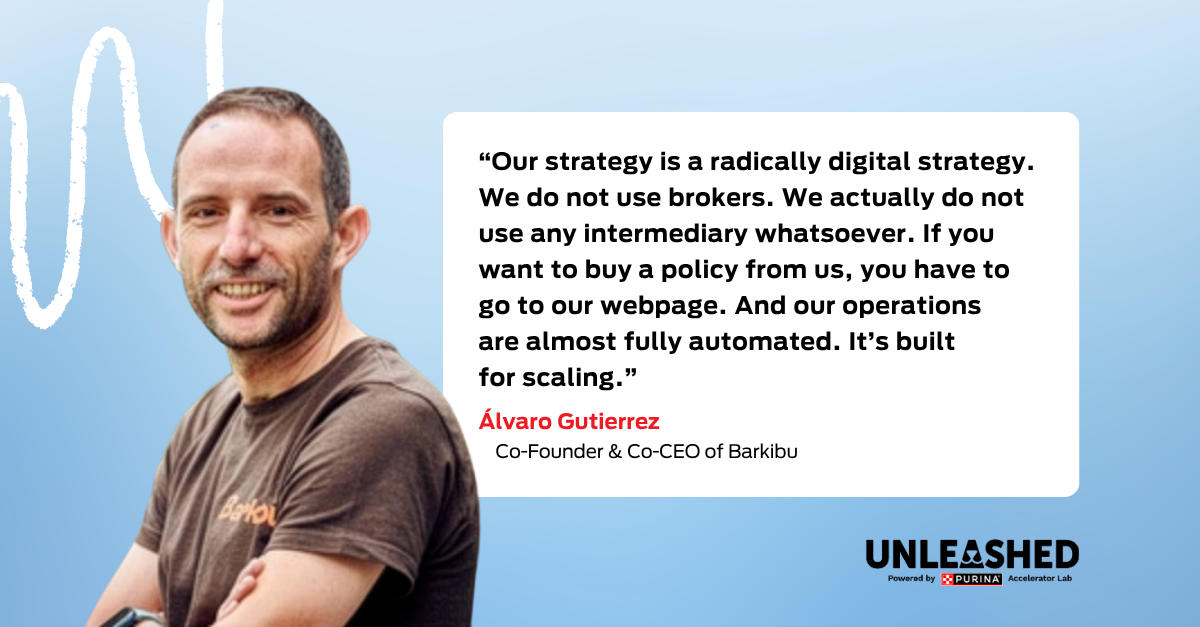
“Our strategy is a radically digital strategy. We do not use brokers. We actually do not use any intermediary whatsoever. If you want to buy a policy from us, you have to go to our webpage. And our operations are almost fully automated. It’s built for scaling,” explained Alvaro Gutierrez, Co-founder & Co-CEO of Barkibu.
Lower complexity, one product and an automated system equals scalable results. But this approach is not without its limitations.
Gutierrez continued, “[Being digital-first and focused on scaling] has its trade-offs. Conversion is one. But we also don't personalise, and each market is at very different levels of development, very different cultures, very different ways of buying.”
So while the human touch may be better equipped to handle complexity, produce higher conversion rates and create strong bonds with the customer base, the fully automated approach could be more scalable and repeatable.
The relationship with vets
The relationship between pet insurers and veterinarians appears to be more contentious than many would assume.
Alexandre Krief, CEO and Co-founder of Kozoo, said, “Older generations of vets used to see insurers as causing harm to their businesses, and the relationship was not easy. Now, with the younger generation of vets, it is facilitating the relationship between insurers and vets.”
Some of the startups I spoke to speak with vets to collect data for claims and may pay them directly. Others focus on the relationship with the pet parent with a pure customer reimbursement model.
Opinions differed when it came to whether insurers should forge network alliances with vets or not, similar to human health.
Henri Dowling from Waggel said, “If the insurer and the vet could work together, for example, to design alternative reimbursement models or maybe form networks, I think that would be fantastic.”
Alvaro Gutierrez has experience in managing vet clinics and mentioned the core fear. “Vets have seen what's happened in human medicine with insurance coming in, first with reimbursement then ending up owning the whole value chain, and having such leverage over clinics that they end up not only foregoing a lot of margin but also affecting clinical quality.”
Ultimately, everyone has the same goal of keeping pets healthier for longer, but how to broker understanding between vets and insurers remains a challenge yet to be solved.
The future of pet insurtech
From the data and the conversations I had with these brilliant minds in the pet insurance space, the prognosis is clear: the sector will continue growing as more pet parents become aware of their options, while companies themselves evolve to better serve their customers.
It’s perfectly plausible that the next pet unicorn comes from insurtech given the scope and adoption gap.
But the shape of that unicorn, whether it's built on preventative care or traditional coverage, vet networks or direct-to-consumer, human expertise or AI automation, will depend on which model can earn trust at scale in a market that's still learning what pet insurance even is.
Written by Olivia de Santos, Pet Tech Writer at Unleashed by Purina.